KWHLAQ
KWHLAQ is a planning and brainstorming tool for helping students take charge of their learning of a new topic - perfect for flipped classrooms.
What is a KWHLAQ chart?
A KWHLAQ chart is an extended version of the very popular KWL chart. Both are teaching tools that help to organize thoughts and ideas, before, during, and after a learning exercise. First, students identify what they know about a topic. Then, they think about what they want to research or learn. After the lesson, they then reflect on what they have learned.
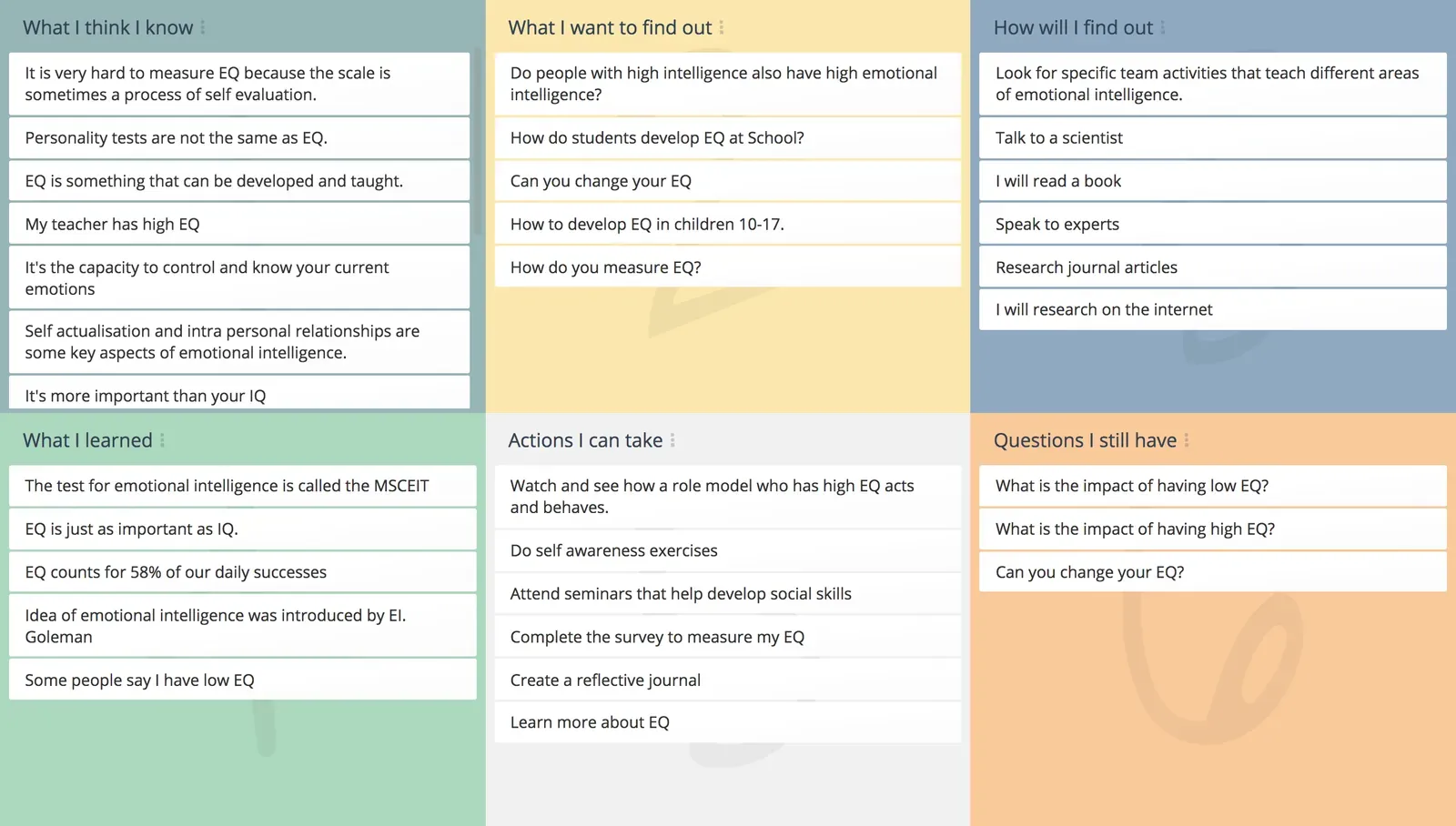
KWHLAQ asks the following questions:
- K – What students already KNOW about a topic?
- W – WHAT students want to learn or find out?
- H – HOW they will research or find the information they want to learn?
- L – What students have LEARNED about the topic after taking action?
- A – How will students APPLY the knowledge they’ve learned?
- Q – What QUESTIONS they still have or have thought of as a result of the learning exercise?
If the full six columns are more than a lesson needs, the KWL chart covers K, W and L on their own, and there is a free printable KWL chart in PDF if you want a paper handout for the class.
Why do a KWHLAQ chart?
The KWHLAQ chart is a simple but effective instructional technique which puts the student at the center of inquiry-based learning. In addition to the benefits of the basic KWL Chart, the extended version:
- Provides teachers with valuable information as to what students already know about a given topic (diagnostic assessment).
- Builds collective learning by helping students to learn from each other (peer-to-peer learning).
- Enables teachers to create more enjoyable lesson plans that address the interests, questions, and needs of the students
- Creates interest and curiosity and encourages students to expand their ideas beyond the lesson or training provided in the classroom environment.
- Facilitates a more authentic experience by asking them how they will apply their knowledge.
Who should use a KWHLAQ chart?
A KWHLAQ chart is useful for both group and independent learning and formative assessment. Teachers and trainers can use this technique to create customized, student-centric lesson plans while still linking to a curriculum or organizational learning goals. Independent researchers can use the model to organize their ideas and keep track of their progress.
Because the KWHLAQ methodology presents information as a sequence of scaffolded steps, it is especially useful for visual, young, and ESL learners.
KWHLAQ chart template
What I KNOW
Identify what the students already know.
Complete before planning and delivery of the lesson.
What I WANT to know
Investigate what students want to know.
Reinforce that knowledge gaps are not a deficiency but an opportunity to grow. Complete before planning and delivery of the lesson.
HOW will I find out
Assess strategies, resources, and tools available to help find the answers and create a plan.
Complete before research or delivery of the lesson.
What I LEARNED
Information about what the students have learned.
Complete during and after delivery of the lesson.
How I will APPLY this knowledge
Develop a list of how they can apply their new knowledge.
Complete after delivery of the lesson.
QUESTIONS I still have
Identify questions that remain and new questions that arose as a result of the exercise.
Complete after delivery of the lesson.
References
- Langwitches. 2015. “An Update to the Upgraded KWL for the 21st Century.” Blog.
- Barell, John F. Why Are School Buses Always Yellow?: Teaching for Inquiry, K-8. Corwin Press, 2016.
Save effort, time and money with GroupMap
GroupMap offers more than just an online digital whiteboard. Its innovative platform is designed to enhance the quality of your team’s decisions. With features that prevent bias and keep facilitation simple, GroupMap makes sure no single voice dominates and keeps conversations productive and inclusive. Its intuitive interface is easy for anyone to use, and its scalable design supports small teams and large groups whether they are face to face or around the globe. Customizable templates and workflows keep discussions focused on objectives, helping you drive actionable outcomes each and every time.
Frequently asked questions
What is a KWHLAQ chart?
What does KWHLAQ stand for?
How is KWHLAQ different from a KWL chart?
When should teachers use a KWHLAQ chart?
Can a KWHLAQ chart be used for independent learning?
How to run it in GroupMap

Set topic
Define the topic of the KWHLAQ chart.

Brainstorm (KWH)
Write down everything you know and want to know about the topic, and how you can learn.

Review (KWH)
Review results, discuss and prioritize.

Run lesson
Students do the research, or the lesson is delivered.

Brainstorm (LAQ)
Write down everything you learned about the topic, how you will apply this knowledge, and any questions that remain.

Review (LAQ)
Review and reflect on the results, discuss.
Ready to get everyone on the same page?
Start a free GroupMap and turn your next discussion into clear, shared decisions.