PESTLE Analysis
PESTLE analysis examines Political, Economic, Social, Technological, Legal and Environmental factors. See a sample PESTLE analysis and use our free template.
What is PESTLE Analysis?
A PESTLE analysis extends the PEST model used for environmental scanning. It covers Political, Economic, Social, Technological, Legal and Environmental factors that could have a direct or long-lasting impact on the organization.
It is used as part of strategic planning or risk management. It gives the group a shared picture of what is happening around the organization and what the plan needs to allow for.
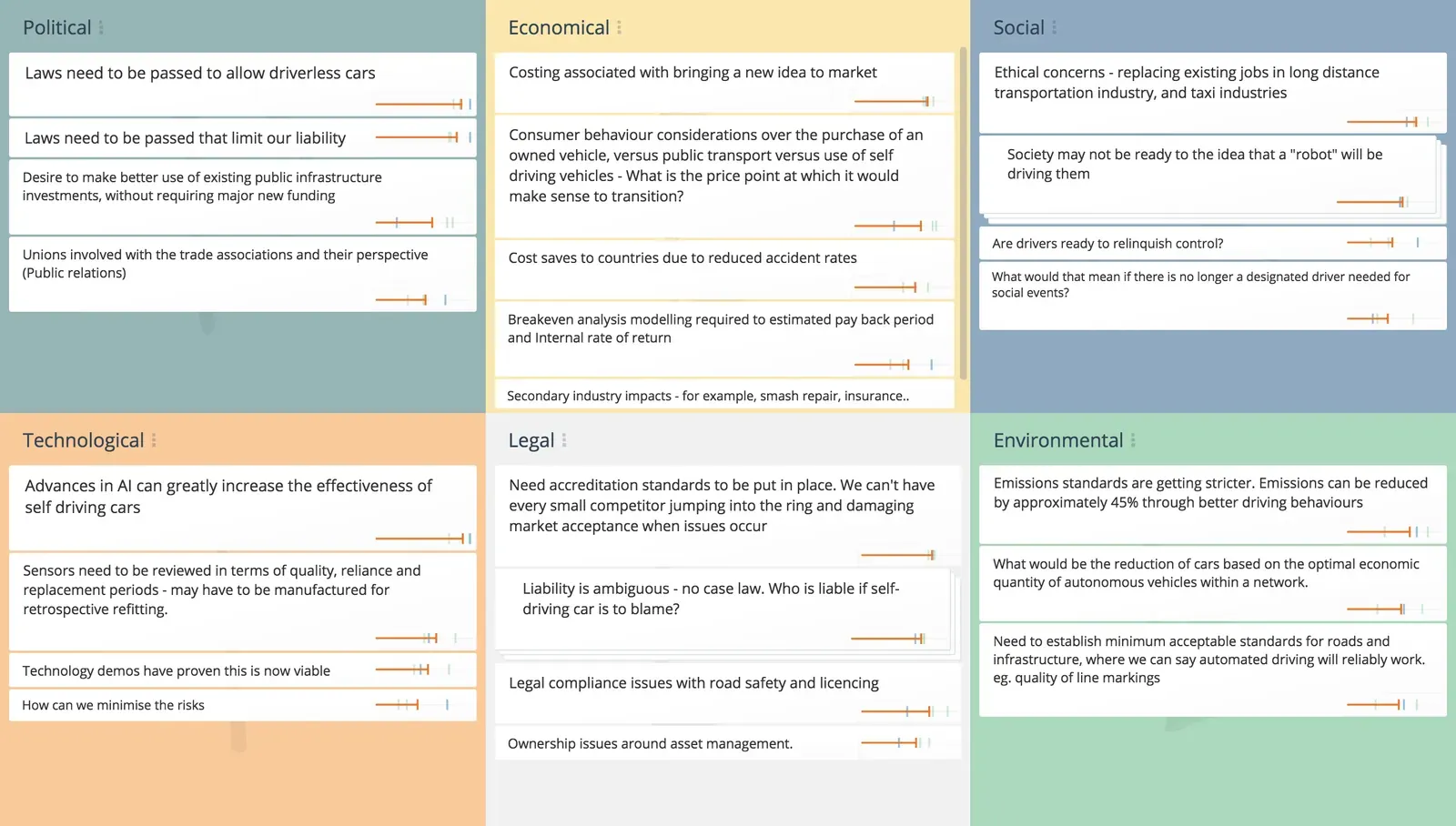
The output from a PESTLE analysis is often used as an input for other business management tools such as SWOT analysis, SOAR analysis, risk assessment, or a Business Model Canvas.
There are many variations of this framework, which examine different combinations of external factors, specific to particular industries. Examples include: PEST, STEEPLE, STEER and STEEP.
Key takeaways
- A PESTLE analysis scans six external factors (Political, Economic, Social, Technological, Legal, and Environmental) that could affect an organization.
- It extends the older PEST analysis by adding Legal and Environmental factors.
- Rate each factor for impact to see which forces to plan around first.
- Its output feeds a SWOT analysis, risk assessment, or Business Model Canvas. See the sample PESTLE analysis below.
Why do a PESTLE Analysis?
A PESTLE analysis helps a team to understand the organization’s market and business position better, plan strategically, and conduct market research in new and existing markets. The framework:
- Encourages strategic thinking and helps you evaluate how your strategy fits into the broader environment
- Provides an overview of the crucial external influences on the organization
- Allows leaders to make more decisive and knowledgeable decisions
PESTLE template
The PESTLE template has one area for each of the six external factors:
| Factor | What it covers | Example |
|---|---|---|
| Political | Government policy, stability, trade, and tax rules | Import tariffs, employment regulation |
| Economic | Growth, inflation, interest, and exchange rates | Rising interest rates squeeze spending |
| Social | Attitudes, demographics, and lifestyle trends | Demand for ethical, sustainable products |
| Technological | Innovation, automation, and emerging tech | Mobile ordering and loyalty apps |
| Legal | Laws and regulatory requirements | Data-protection and labeling rules |
| Environmental | Climate, sustainability, and natural resources | Packaging-waste and emissions targets |
Political
Political or politically motivated factors that could affect the business.
Examples include:
- Government policy and political stability or instability
- Tax policy, foreign trade policy and trade restrictions
- Labor, environmental, copyright and consumer protection laws, and competition regulation
- Bureaucracy and corruption
- Funding grants and initiatives
Questions to ask:
- What government policies or political groups could be beneficial or detrimental to our success?
- Is the political environment stable or likely to change?
Economic
Overall economic forces that could affect what you’re trying to do.
Examples include:
- Economic trends, growth rates and industry growth
- Inflation, interest rates and international exchange rates
- Taxation and monetary policy
- Labor costs and raw material costs
- Consumer disposable income and unemployment rates
- Availability of credit, international trade and seasonal factors
Questions to ask:
- What economic factors will impact on us moving forward?
- Does the current economic performance affect us?
- How does each economic factor impact our pricing, revenues, and costs?
Social
Social aspects, attitudes, and trends that influence your business and target market.
Examples include:
- Attitudes and shared beliefs about health, work, leisure, money and customer service
- Views on imports, religion, cultural taboos and the environment
- Population growth and demographics
- Family size and structure, immigration and emigration
- Lifestyle trends
Questions to ask:
- How do our consumers’ values and beliefs affect their buying habits?
- How does human behavior or cultural trends play a role in our business?
Technological
Technology that can affect the way you make, distribute, and communicate your products and services.
Examples include:
- Technology and communications infrastructure
- Consumer access to technology
- Emerging technologies and automation
- Research, innovation and technology incentives
- Legislation on technology and intellectual property
- Competitors’ technology and development
Questions to ask:
- What innovations and technological advancements are available or on the horizon?
- How might they affect our operations?
Legal
Current and future legal and regulatory requirements impacting on the business.
Examples include:
- Laws on consumer protection, labor, and health and safety
- Antitrust, intellectual property and data protection law
- Tax and anti-discrimination law
- International and domestic trade regulations and restrictions
- Advertising standards, product labeling and safety standards
Questions to ask:
- What regulations and laws apply to our business?
- Do they help or hinder our business?
- Do we understand the laws across all our markets?
Environmental
Environmental forces affecting the geographical location of your business and your customers, the surrounding environment, and the natural resources your organization uses.
Examples include:
- Weather and climate change
- Your carbon footprint
- Environmental regulations, pollution laws and targets
- Recycling and waste management policies
- Endangered species and support for renewable energy
Questions to ask:
- How does our physical environment affect us and vice versa?
- What are the effects of climate, weather or geographical location?
- Are we prepared for future environmental targets?
PESTLE analysis example
Here is a short sample PESTLE analysis for a coffee-shop chain planning to expand into a new country:
- Political – Import tariffs on coffee beans and local employment regulations affect cost and hiring.
- Economic – A weaker local currency and rising interest rates squeeze consumer spending on discretionary treats.
- Social – Growing demand for ethically sourced coffee and plant-based milk options.
- Technological – Mobile ordering and loyalty apps are now expected by customers.
- Legal – Food-safety standards, labeling laws, and data-protection rules for the loyalty app.
- Environmental – Pressure to cut single-use cups and meet packaging-waste targets.
Rating each factor for impact shows where to focus. Here, the social shift to sustainability and the technological expectation of mobile ordering stand out as the biggest factors to act on first.
How to do a PESTLE Analysis
While you can analyze the factors in the PESTLE template against the current status, you should also consider how potential changes might impact on your future.
Different industries may place more significance on one or more of the areas. For example, there is likely to be a very different emphasis for businesses involved in tourism, compared with those in the health, information technology, mining, banking, and defense industries.
The framework is most useful when you get input from participants with a range of different perspectives. Getting everyone together at the same time may be difficult in large or geographically dispersed teams. Video conferencing, online documents, and collaborative brainstorming tools such as GroupMap can solve many of these difficulties.
Who is involved in a PESTLE Analysis?
A PESTLE analysis is useful in all industries at the strategic, departmental, and project level to assess current and future markets. Use it as a key input for planning, marketing, organizational change, business and product development, project management, and research reports.
PESTLE analyses are usually part of the organization’s strategic planning process and help set its future direction. The invite list often includes senior managers, C-level executives, other leaders, major stakeholders, partners and consultants, and sometimes major clients.
Tips for facilitating an effective PESTLE Analysis
- Carefully select participants to provide expert knowledge but also a fresh perspective.
- Do not just list the factors you already know or have heard of. Check each one against reliable information, then rate its impact on your organization.
- Rating the impact of each factor lets you identify the most important issues.
- For complex organizations and where they are servicing multiple locations, there may need to be a PESTLE analysis for each environment.
- Use quantitative data where possible to focus on the crux of the issue.
- Provide adequate time in the session to rank and prioritize ideas.
- You can also have people vote or color code factors that are temporary, long term or should be monitored over time.
- Try to keep factors relatively high level and avoid getting bogged down in analysis paralysis.
Related templates
References
-
Aguilar, Francis. 1967. “Scanning the Business Environment.” *New York: The Macmillan Company. p239.
-
Chartered Management Institute – Carrying out a PEST Analysis Checklist

Save effort, time and money with GroupMap
GroupMap offers more than just an online digital whiteboard. Its innovative platform is designed to enhance the quality of your team’s decisions. With features that prevent bias and keep facilitation simple, GroupMap makes sure no single voice dominates and keeps conversations productive and inclusive. Its intuitive interface is easy for anyone to use, and its scalable design supports small teams and large groups whether they are face to face or around the globe. Customizable templates and workflows keep discussions focused on objectives, helping you drive actionable outcomes each and every time.
Frequently asked questions
What is a PESTLE analysis?
What is a sample PESTLE analysis?
What is the difference between PEST and PESTLE?
When should you use a PESTLE analysis?
Who should be involved in a PESTLE analysis?
How to run it in GroupMap

Brainstorm
Brainstorm ideas for each area of the PESTLE template.

Group
Review responses, and collate ideas.

Rate
Rate the ideas according to likely impact on the organization.

Share
Share the outcomes of the session to relevant stakeholders.
Ready to get everyone on the same page?
Start a free GroupMap and turn your next discussion into clear, shared decisions.