Stakeholder Mapping and Analysis
Stakeholder mapping plots who has influence and who has interest, so you know who to manage, satisfy, inform and monitor. Five methods, two worked examples and a free template.
What is stakeholder mapping?
Stakeholder mapping is the process of identifying everyone who can influence your project, or who has an interest in its outcome, and plotting them on a grid so you can decide how to engage each group. Most maps use two axes, influence and interest, which sorts people into four groups: manage closely, keep satisfied, keep informed, and monitor.
It is the practical half of stakeholder analysis. Analysis is the wider discipline of working out who matters and why. Mapping is the session where a group puts names on a grid and agrees what to do about each one.
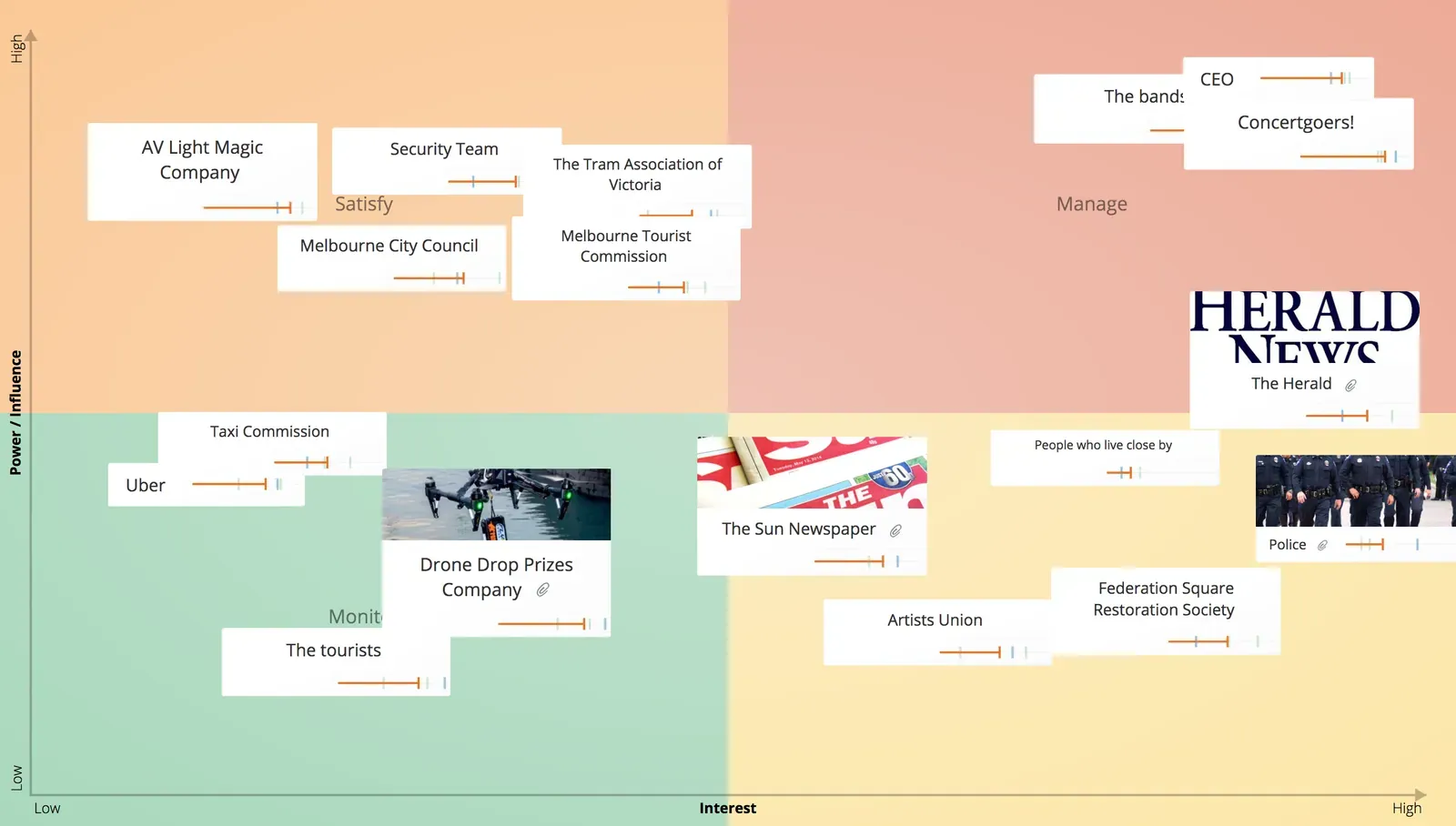
Key takeaways
- Stakeholder mapping identifies everyone who can influence, or has an interest in, a project, then plots them on a grid.
- The power/interest grid, also called the Mendelow matrix, sorts stakeholders into manage closely, keep satisfied, keep informed, and monitor.
- Engage each quadrant differently: involve the high-influence, high-interest players closely and simply monitor the rest.
- Build the map as a cross-functional group so no key stakeholder is missed. See the two worked examples below.
Why do stakeholder mapping?
Understanding who your stakeholders are, and the impact they may have on your business or project, is crucial to success. Not engaging key players in the right way at an early stage can have bad results for a project. Building a stakeholder map:
- Creates a shared understanding of the key people who can affect your success.
- Provides a foundation for your communications and engagement strategy.
- Identifies potential risks from negative stakeholders, or those who feel they are not being heard.
- Prioritizes stakeholders so the right amount of resource goes to the right group, with the right engagement strategy.
Five stakeholder mapping methods
The power/interest grid is the best known method, but it is not the only one. Choosing the right one depends on what you need to decide.
| Method | What it plots | Use it when |
|---|---|---|
| Power/interest grid | Influence against interest | You need a fast, shared view of who to engage and how closely. This is the default, and the one this template builds. |
| Salience model | Power, legitimacy and urgency together | Several groups are competing for attention and you need to judge whose claim comes first. |
| Knowledge-base chart | What each stakeholder knows about the project | Your risk is misinformation or an information gap, rather than opposition. |
| Power-predictability matrix | Influence against how predictable their behavior is | The unknown is not whether someone can affect the project, but how they will react. |
| Relationship mapping | The connections between stakeholders | Influence travels through relationships, and you need to find who can reach whom. |
Most teams start with the power/interest grid and add a second method only when the first leaves a real question unanswered.
The stakeholder mapping template
A stakeholder map gives a visual representation of the relative importance of your stakeholders. The two common axes are:
- Level of interest. How much a stakeholder cares about the outcome. Are they beneficiaries, or will there be negative effects?
- Level of influence. The degree to which a stakeholder can make or break the project, for example through funding, legislation or protest.
Other dimensions may suit some organizations better, such as level of investment, level of support from adversary to advocate, or need for outcomes.
Plotting influence against interest is also known as a power/interest grid or Mendelow matrix. The resulting stakeholder matrix indicates what kind of engagement each group needs.
| Quadrant | Influence | Interest | Engagement strategy |
|---|---|---|---|
| Manage closely | High | High | Key players. Involve in decisions and engage regularly. |
| Keep satisfied | High | Low | Keep on side. Getting them offside is a risk. |
| Keep informed | Low | High | Consult and keep informed to retain their support. |
| Monitor | Low | Low | Monitor periodically. Their relevance may change. |

Keep satisfied: high influence, low interest
These stakeholders are highly influential but they do not have much interest, and they are not actively engaged in your project.
Consider their objectives and keep them satisfied so they remain advocates. Getting them offside is a risk.
Examples: regulators such as an environmental or food-safety agency, and administrators with discretion over budgets.
Monitor: low influence, low interest
These stakeholders sit on the periphery. They are neither interested nor influential.
Monitor their activity from time to time. Their relevance may change. Keep them informed to encourage interest.
Examples: support and complementary services.
Manage closely: high influence, high interest
These are your key stakeholders. They have a lot of influence and a strong interest in the outcome. Manage them well to build strong relationships and retain support. Involve them in decisions and engage regularly.
Examples: trade unions, politicians and senior officials, investors, senior management, project sponsors.
Keep informed: low influence, high interest
These stakeholders care a great deal about your project but have little power to influence it.
Anticipate their needs and keep them informed to retain their support. Consult them on their area of interest and use their input to improve your chances of success.
Examples: end users of a program or product, community members, community action groups, media outlets.
Stakeholder mapping examples
Example one: rolling out a new HR system
A project team is replacing the HR system used by every employee. They brainstorm everyone affected, then place each group on the grid.
- Manage closely: the HR director, who owns the outcome, and the project sponsor, who controls the budget. Both sit in every key decision.
- Keep satisfied: the finance lead and the IT security lead. Neither wants to be involved week to week, but either can stop the rollout. Periodic sign-offs keep them on side.
- Keep informed: the employees and line managers who will use the system daily. They cannot change the decision, but adoption depends on them, so they are consulted and updated throughout.
- Monitor: the external payroll supplier, whose involvement is minor until go-live.
Rating each group from adversary to advocate then reveals who needs winning over before the rollout begins. Here it was the line managers, who had been through a failed system change before.
Example two: a school consulting its community on a new timetable
A school is changing its daily timetable, which affects families, staff and local services.
- Manage closely: the school board and the principal, who approve the change, and the teachers’ representative, whose members work the hours.
- Keep satisfied: the education department, which sets the rules the timetable has to satisfy but takes no interest in the detail.
- Keep informed: parents and carers, who care intensely and will judge the outcome, but who do not make the decision. This is the largest group and the one most likely to be under-served.
- Monitor: the local bus operator and nearby after-school programs, whose schedules may need to shift later.
The map makes the risk obvious. The group with the most feeling has the least formal influence, so a consultation that only informs them is likely to produce a backlash.
What are the four steps of stakeholder mapping?
- Identify your stakeholders. Build a categorized list of everyone interested in, affected by, or influential over the work.
- Position them on the map by influence and interest.
- Rate their level of support, from adversary to advocate.
- Agree the actions and communication for each group, with owners and timeframes.
What is the best tool for stakeholder mapping?
Any tool that lets a group position stakeholders together and keeps a record of the reasoning. A whiteboard and sticky notes works for a group in one room. For a group that is spread out, or where you want to prevent one loud voice from anchoring every placement, an online tool lets people position stakeholders independently first and then shows the group average. That is how GroupMap runs it, and it removes the collation work between the session and the report.
What are the 7 C’s of stakeholder management?
A commonly used checklist for keeping engagement honest: clarity about what you want, context about their situation, consistency in what you say, credibility so you are believed, commitment that outlasts the launch, communication that goes both ways, and collaboration where they can shape the outcome. It is a reminder that mapping is only the first step. What you do with the map is stakeholder management.
Common mistakes in stakeholder mapping
- Defining stakeholders too broadly, so “the community” hides four groups with different interests.
- Mapping once and never revisiting. A stakeholder map is not static, and positions move as a project progresses.
- Relying on a single perspective. One person’s map reflects one person’s blind spots.
How to run a stakeholder mapping session
Assemble a cross-functional group with a range of perspectives on the business, product, service or project. The quality of the outcome depends on the insight of the participants, and a diverse group helps to identify key stakeholders from across the whole organization.
There are six general steps. The time required varies with the organization, the size of the group and the focus of the session, but there is no reason the map cannot be completed within an hour. A full communications plan in response to the map takes longer.
Give context and define the scope. Make sure everyone understands the purpose of the session and how the results will be used. Goals depend on the industry, the organization, the stage of the project, and your current engagement objectives. For example, will the session cover current stakeholders, or those potentially affected by a new initiative?
Present information that gives context for the map. That might include results from a business impact assessment, a Business Model Canvas, a SWOT analysis or a PESTLE analysis, industry trends and news, and the relevant rules and regulations.
Define the criteria for each axis. These definitions can differ a great deal from one analysis to another.
Then build a categorized list of the people or groups interested in or affected by your work, or who have power over what you do. Stakeholders usually fall into two categories: those who contribute to the initiative, and those affected by it. Some fit both.
Examples of stakeholder groups include owners and investors, direct and indirect customers, employees and beneficiaries, suppliers, competitors and industry associations, the community including residents and special interest groups, and government authorities and regulatory bodies.
Questions to consider:
- Will this stakeholder be affected by the project?
- Can they influence it?
- Do they control or influence any resource you need?
- Do they have skills or capabilities you need?
- At what stage does this stakeholder have the most impact?
Gather ideas on a whiteboard, sticky notes, poster paper, or in an online tool such as GroupMap. An online tool greatly reduces the time and effort of collating and organizing the information in the steps that follow.
Once you have a complete list, position each stakeholder on the map to show their relevance relative to one another. The matrix shows how critical each one is and where to focus your engagement effort.
This can be done individually, or in small groups then combined, or as a facilitated discussion. A tool like GroupMap saves considerable effort here, especially with the individual-first approach, because the software produces the group average automatically.
Rating each stakeholder on their level of support adds a third dimension. Advocates will help you succeed. Adversaries will make things difficult, and you will need to work to bring them on board and manage their objections.
Discuss and add comments against each stakeholder to inform later actions. It is neither practical nor necessary to communicate with every stakeholder at every stage. The more information you have, the easier it is to prioritize.
Once the group agrees it has identified the key stakeholders, decide the follow-up activities, along with the people, expertise and budget needed. You may need interviews or forums with key players to work out what motivates them, what information they want, and how they want to receive it, before you write your communications plan.
Finally, compile a report containing the stakeholder rankings, the planned actions, who owns them, and the timeframes. Use it to communicate outcomes and encourage buy-in, monitor the status of actions as they change, provide a foundation for future sessions, and feed other planning processes. GroupMap generates reports in several formats automatically, which saves the write-up after the workshop.
Who uses stakeholder mapping?
Stakeholder management matters to every organization, program and project. Stakeholder mapping is useful across all industries, all levels of an organization and all departments, for existing and new businesses, and for projects and business processes.
Use it in regular organizational reviews, when assessing changing business conditions, when developing new initiatives, and as part of a broad environmental scan for early planning.
It matters most in the early stages, and for projects that affect the community, span multiple teams or organizations, cross cultural boundaries, or have external investors.
Related templates
Tips for effective stakeholder mapping
- Choose participants who bring expert knowledge, and some who bring a fresh perspective.
- Use technology to include critical people in other locations rather than lose their contribution.
- Be specific rather than broad when defining stakeholders.
- Allow enough time in the session to position and rate people properly.
- Communicate outcomes, and update the map as the project moves.
Save effort, time and money with GroupMap
GroupMap offers more than just an online digital whiteboard. Its platform is designed to improve the quality of your team’s decisions. With features that prevent bias and keep facilitation simple, GroupMap ensures no single voice dominates and keeps conversations productive and inclusive. The interface is easy for anyone to use, and it scales from small teams to large groups, whether they are in one room or spread around the world. Customizable templates and workflows keep discussions focused on objectives, so you get actionable outcomes every time.
Frequently asked questions
What is stakeholder mapping?
What are the four steps of stakeholder mapping?
What is a stakeholder matrix or power/interest grid?
What does a stakeholder map look like?
What are common mistakes in stakeholder mapping?
How to run it in GroupMap

Scope
Give context and identify the scope of the stakeholder analysis

Brainstorm
Gather a comprehensive list of stakeholders.

Position
Position stakeholders according to their influence and interest.

Rate
Rate each stakeholder based on their level of support – from adversary to advocate

Action plan
Identify actions, assign responsibilities and timeframes

Share
Report on the outcomes and monitor as part of your communications strategy
Ready to get everyone on the same page?
Start a free GroupMap and turn your next discussion into clear, shared decisions.