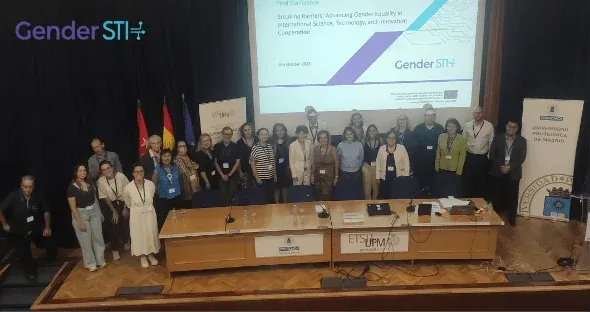
Co-creating gender equality in science and technology: the global impact of the Gender STI Co-Design Labs with GroupMap
Discover how GroupMap helped identify ways to bridge the gender gap in international science, technology and innovation through the Gender STI project.
Discover how FUTOUR and GroupMap co-created strategic prototypes and policy recommendations for the European initiative Gender STI, mobilizing experts and policy makers across four continents.
Introduction to FUTOUR
FUTOUR is an agency specializing in empowering people and organizations to shape their future and be the drivers of the change they want to achieve. Its global pursuit is that of generating happy, fulfilled, resilient people and organizations through the power of facilitation. FUTOUR stems from over 30 years of collaboration in the design and implementation of Future Centers, living labs, creativity hubs through its practical experience in facilitating positive change and impact through participatory processes, methods and techniques. FUTOUR has been designed as a nomadic, mobile Future Center bringing facilitation and participatory techniques wherever they were needed. Its team worked in 5 continents and over 50 countries for organizations, companies and communities.
FUTOUR employs a range of participatory methods and tools to foster collaboration and co-creation among stakeholders. Their approach is flexible, offering solutions for dynamic and fixed-site projects, events, and client venues, all designed to harmonize spaces and facilitate creative processes.
About Paolo Martinez
Paolo Martinez is an IAF Certified Professional Facilitator (CPF) with extensive experience in facilitation, creative problem solving and innovation. As a partner at FUTOUR, he specializes in designing and implementing participatory processes that foster collaboration among diverse stakeholders. Paolo led two organizations as lead facilitator to receive the prestigious Platinum IAF Facilitation Impact Award: the Emilia-Romagna Region in Italy and the most important Italian motorway company, Autostrade per l’Italia (ASPI). His expertise spans various sectors, including foresight, strategic planning, public policy and conflict management, where he applies innovative methodologies to drive sustainable change.
Here, Paolo shares his success story as the lead process architect and methodological coordinator of the Gender STI Co-Design Labs, seamlessly orchestrating human facilitation dynamics and digital collaborative environments.
Co-creating gender equality prototypes and global policy recommendations
Ensuring gender equality and fostering diversity in Science, Technology, and Innovation (STI) is both a critical human rights imperative and an economic necessity worldwide. The international Gender STI project, funded under the European Union’s Horizon 2020 research and innovation framework (Grant Agreement No. 872427) and coordinated by Universidad Politécnica de Madrid (UPM) alongside a global consortium including FUTOUR, INMARK, SPI, CNRS, VTT, TU Graz, and regional international partners, tackled the systemic challenge of embedding the gender perspective into bilateral and multilateral STI dialogues between Europe and key third countries.
To achieve this, FUTOUR designed and facilitated a series of international Co-Design Labs powered by GroupMap. The initiative mobilized over 70 high-level international experts, policy makers, funding agency executives, research leaders, and gender scholars across Europe, the Americas, Africa, and Asia. This co-creative journey resulted in concrete strategic prototypes and an actionable Policy Recommendations Plan presented directly to the European Commission.
The challenge: breaking systemic gender barriers in international STI cooperation
Despite decades of institutional interventions, women remain significantly underrepresented in scientific careers globally, accounting for only about 30% of researchers worldwide. Academic and scientific pathways continue to suffer from the “leaky pipeline” phenomenon and persistent glass ceilings in decision-making bodies. Furthermore, explicit gender equality provisions have historically been absent or minimal in international bilateral and multilateral cooperation agreements between EU Member States, Associated Countries, and third countries.
Addressing these issues across a multi-continental footprint, engaging stakeholders from Argentina, Brazil, Canada, Chile, China, India, Mexico, South Africa, South Korea, the United States, and EU Member States, demanded an approach far beyond traditional top-down directives. The project required a bottom-up, participatory framework capable of bridging distinct socio-cultural contexts, building mutual trust, and driving consensus among diverse international institutional actors.
The methodology: an innovative and participatory journey
FUTOUR deployed its Societal Innovation Camp (IC) methodology integrated with human-centered Design Thinking frameworks to guide participants from initial problem exploration to field-ready prototypes with specifically designed GroupMap canvases:
-
Phase 1: Diagnostic and Preparation (Asynchronous & Onboarding): Stakeholder mapping across the Quadruple Helix, development of Participant Guides, and creation of structured Challenge Canvases. Digital workspaces on Basecamp and GroupMap enabled pre-lab alignment and knowledge sharing across time zones.
-
Phase 2: Core Co-Creation & Consensus Building (Synchronous & Asynchronous Labs): Facilitated online workshops structured across geographic hubs (West Lab for Americas/Europe; East Lab for Asia/Africa/Europe) focusing on three European Research Area (ERA) priority axes:
- Gender equality in scientific careers;
- Gender balance in decision-making bodies and positions;
- Integration of the gender dimension in research and innovation content.
Facilitators combined World Café dynamics on digital canvases, the ToP ORID (Objective, Reflective, Interpretive, Decisional) framework, and Consensus Workshops with deep-dive interviews inspired by Theory U / Sensing Journeys to uncover hidden biases and systemic leverage points.
-
Phase 3: Experiential Prototyping & Roadmapping (6-6-6 Framework): Working groups translated abstract ideas into actionable roadmaps structured across three implementation horizons: 6 weeks (quick wins), 6 months (institutional testing), and 6 years (systemic change), producing detailed pitch presentations, prototype dossiers, and video clips.
-
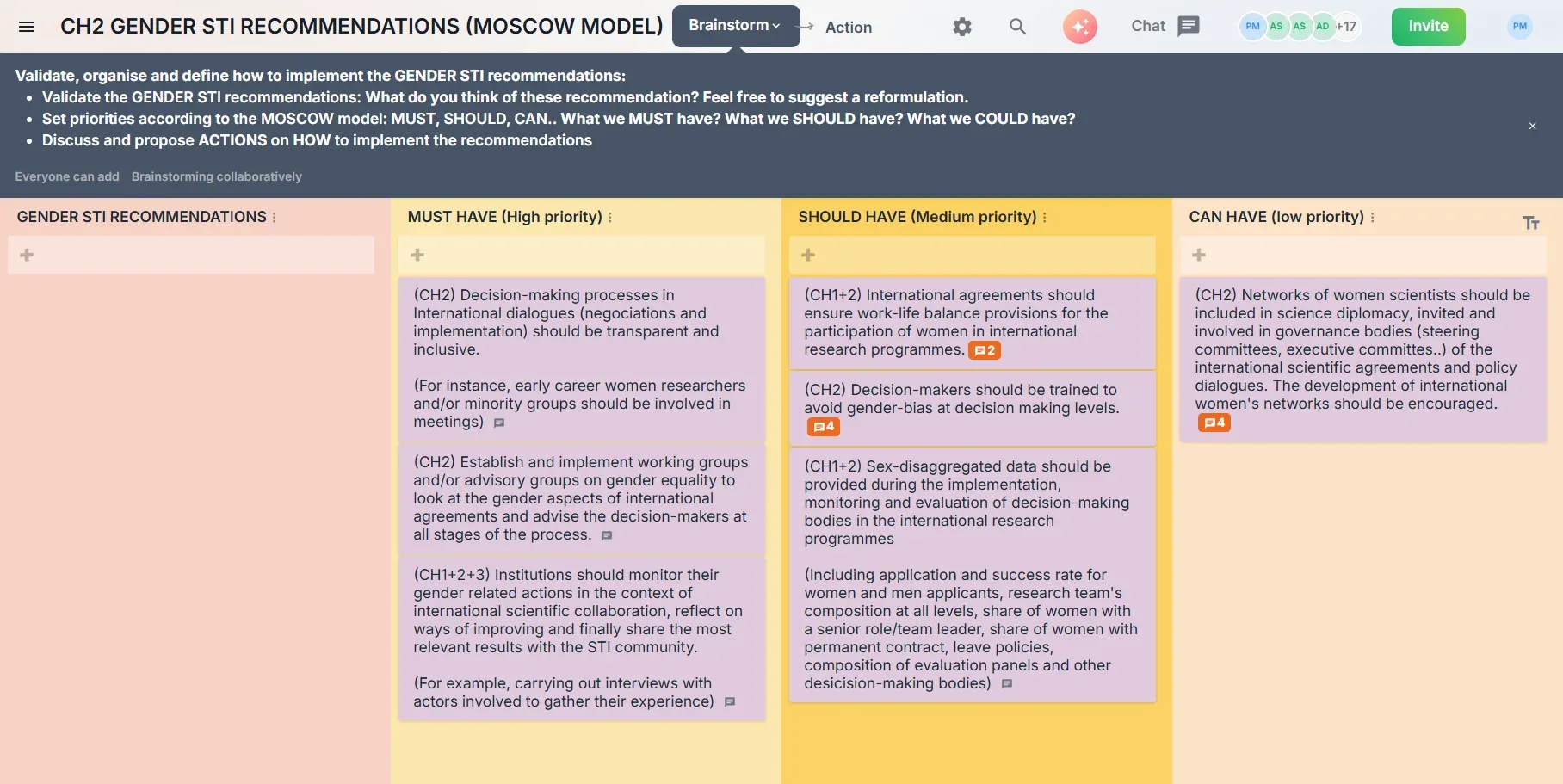
Phase 4: Policy Recommendations: After the design of specific criteria and approaches to increase gender balance in STI in international collaboration, the team defined the priorities and designed a policy recommendation document for the European Commission by applying the MoSCoW (Must have, Should have, Can have and Will not have) framework with GroupMap through a facilitated session involving 21 international experts.
The role of GroupMap
The digital collaboration platform GroupMap served as the core decision support engine within FUTOUR’s facilitation architecture:
- Effective Brainstorming: Provided a transparent, structured, and inclusive environment where participants shared insights simultaneously, eliminating hierarchical barriers and ensuring every voice, regardless of native language or career seniority, contributed equally.
- Organization of Ideas: Enabled real-time clustering, categorizing, and thematic synthesis of hundreds of inputs generated during consensus workshops, converting complex qualitative discussions into structured visual maps.
- Decision Support: Facilitated multi-criteria voting and real-time prioritization. Objective data collection enabled international teams to achieve transparent, consensus-driven decisions on which prototype concepts to advance into the formal validation phase.
The impact and results
The participatory architecture designed by FUTOUR and enabled by GroupMap delivered high-value strategic outcomes:
- Concrete Deliverables & Prototypes Developed: Co-creation of 21 strategic action prototypes across the Co-Design Lab cycles, including:
- International Mentorship Networks & Schemes: Structured support mechanisms for female researchers designed to reduce academic drop-out rates.
- Simulation-based Bias Games: Interactive tools to diagnose and dismantle implicit gender stereotypes in STEM fields.
- Gender STI Prototyping Matrix: A novel analytical framework mapping strategic actions directly onto international STI agreement typologies and policy dialogues.
- Inclusive Design & Argument Banks: Practical toolkits and evidence banks assisting researchers and funding agencies in integrating sex and gender analysis into research proposals.
- Quantifiable Metrics & Scale:
- Engagement of 70+ key international experts and decision-makers spanning 16+ countries across 4 continents.
- Delivery of the formal Policy Recommendations Action Plan, submitted to the European Commission and shared with research ministries and funding bodies globally.
- Establishment of the European Observatory on Gender in STI and launching of the global Community of Practice to ensure long-term sustainability.
- 100% alignment with the European Research Area objectives for gender equality and mainstreaming.
Lessons learned
The success of the Gender STI Co-Design Labs highlights that driving structural change in global science policy requires combining expert participatory facilitation with robust digital technology. The synergy between FUTOUR’s Societal Innovation Camp methodology and GroupMap’s decision-support capabilities demonstrated that multi-cultural, cross-border teams can reach consensus on complex policy challenges when given structured, inclusive spaces.
A key operational insight is the importance of balancing bottom-up co-creation with top-down institutional backing. Engaging frontline researchers and gender experts ensured that prototypes addressed real-world operational challenges, while structured digital synthesis gave policy leaders clear, evidence-based recommendations ready for adoption.
Finally, adopting the incremental 6-week, 6-month, 6-year prototyping roadmap provided institutions with an actionable bridge from vision to execution, confirming participatory facilitation as an essential catalyst for global societal innovation.
Next steps
Are you looking to design high-impact participatory processes, international co-design labs, or strategic consensus workshops for your organization or European project? Contact FUTOUR’s facilitation team at info@futour.it or visit www.futour.it.
Ready to transform and shape new approaches to diversity and inclusion? Empower your team, organization and community to drive real change. Start using GroupMap today to turn collaboration into action.
More client stories
 Policy makingCo-creating marine litter solutions in the Mediterranean: the Plastic Busters CAP success story with FUTOUR and GroupMap
Discover how GroupMap helped to identify solutions to reduce marine litter in the Mediterranean through the Plastic Busters CAP project.
 FacilitationCo-creating active safety values and winning the IAF Facilitation Impact Award
Discover how FUTOUR and GroupMap co-created Active Safety Values at Autostrade per l'Italia, earning an IAF Facilitation Impact Award.
 NonprofitHow Strategies for Children uses GroupMap for policy advocacy
Discover how Strategies for Children leverages GroupMap to advance early childhood education advocacy.
Ready to get everyone on the same page?
Start a free GroupMap and turn your next discussion into clear, shared decisions.