TOWS Matrix
The TOWS matrix turns a SWOT into action by pairing strengths, weaknesses, opportunities and threats into SO, ST, WO and WT strategies. See an example.
What is a TOWS matrix?
A TOWS matrix is a strategic planning tool that pairs the four elements of a SWOT analysis (strengths, weaknesses, opportunities and threats) to generate concrete strategies. By systematically crossing internal factors (strengths, weaknesses) with external factors (opportunities, threats), it produces four groups of actions: SO, ST, WO and WT.
Where a SWOT analysis simply lists what is true about a situation, TOWS asks the next question: so what do we do? Introduced by Heinz Weihrich in 1982, it is the action-oriented flip of SWOT. The reordered letters (Threats and Opportunities first) signal the shift from describing the situation to responding to it.
Key takeaways
- TOWS pairs SWOT factors to turn a static list into concrete strategies.
- Four quadrants: SO (use strengths for opportunities), ST (strengths vs threats), WO (fix weaknesses to seize opportunities), WT (defensive, minimize both).
- It crosses internal factors (S/W) with external factors (O/T).
- Run a SWOT first, because TOWS builds directly on its output.
- Its value is generating and prioritizing actions, not just naming factors.
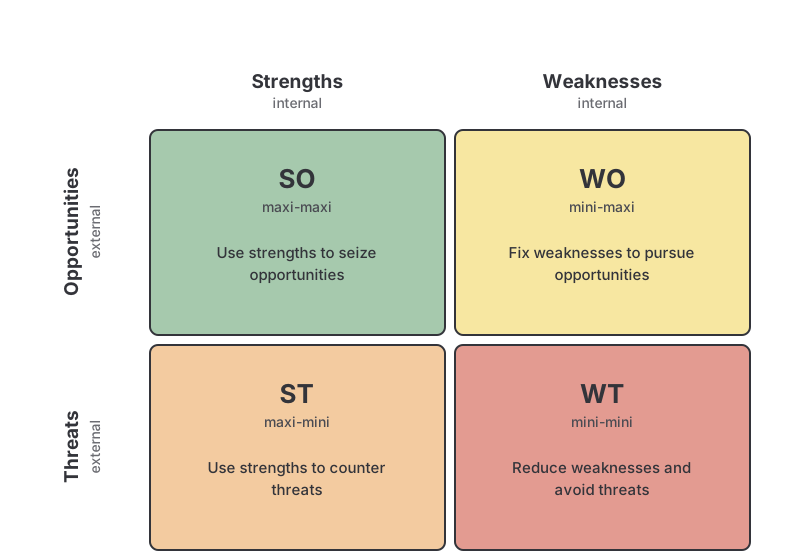
The four TOWS strategies
The matrix crosses internal factors (columns) with external factors (rows):
| Strengths (S) | Weaknesses (W) | |
|---|---|---|
| Opportunities (O) | SO (maxi-maxi): use strengths to seize opportunities | WO (mini-maxi): overcome weaknesses to capture opportunities |
| Threats (T) | ST (maxi-mini): use strengths to counter threats | WT (mini-mini): defensive; minimize weaknesses and avoid threats |
- SO (strengths-opportunities): your most attractive, offensive plays, where a real strength meets a real opportunity.
- ST (strengths-threats): use what you do well to defend against or blunt external threats.
- WO (weaknesses-opportunities): improvement plays that fix or partner around a weakness so you can pursue an opportunity.
- WT (weaknesses-threats): damage limitation, acting defensively to reduce risk where a weakness is exposed to a threat.
Why use a TOWS matrix?
- It converts a SWOT from a descriptive list into an actionable strategy set.
- Pairing factors surfaces options a team would otherwise miss, especially defensive WT and improvement WO moves.
- It forces the group to connect internal reality with the external environment, not treat them separately.
- The four quadrants give a balanced portfolio of offensive, defensive and improvement strategies.
Who should use a TOWS matrix?
TOWS suits leadership teams, strategy and marketing groups, and anyone moving from a completed SWOT toward a plan. It is ideal for annual strategy sessions, business planning, and project kick-offs where the team already knows its situation and now needs an agreed set of actions. If you have not yet mapped your factors, start with a SWOT and bring the results into TOWS.
TOWS matrix example
A mid-size online bookstore has run a SWOT and now builds a TOWS:
- SO: strong recommendation engine (S) + growing demand for curated reading (O) → launch a paid personalized subscription box.
- ST: loyal community (S) + large retailers undercutting on price (T) → double down on community events and author access that price alone can’t match.
- WO: weak mobile app (W) + surge in mobile shopping (O) → invest to rebuild the app to capture mobile buyers.
- WT: thin margins (W) + rising shipping costs (T) → renegotiate carrier contracts and add local pickup to protect profitability.
The output is not four labels but four decisions: a balanced plan spanning growth, defense and improvement.
How to run a TOWS analysis in GroupMap
TOWS is a pairing exercise that thrives on many perspectives, so it works best live with the group.
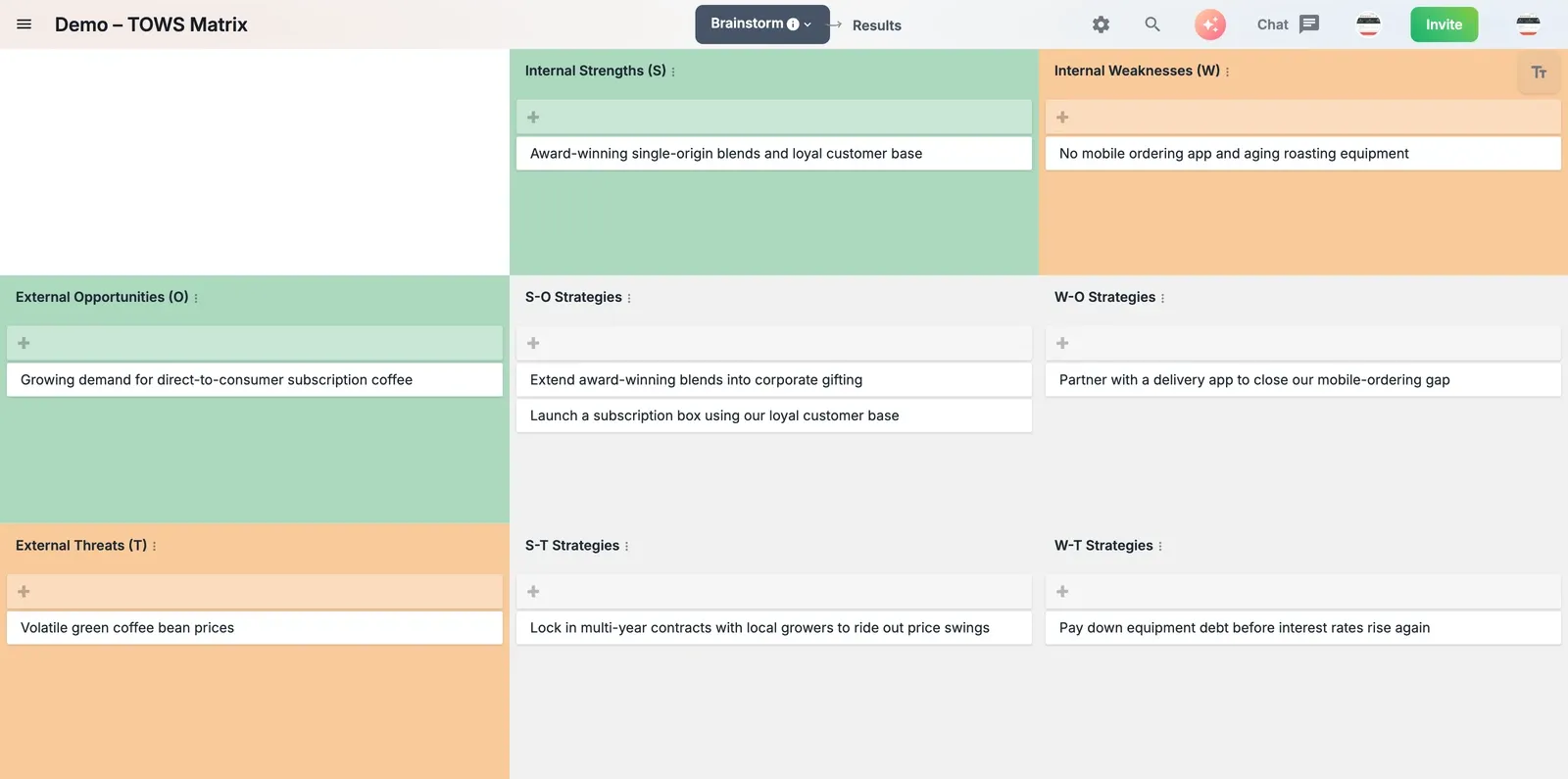
- Bring in your SWOT. Pre-populate the strengths, weaknesses, opportunities and threats, or brainstorm them first.
- Group and clarify. Merge duplicates so you pair a clean, agreed set of factors.
- Generate SO strategies. Ask: how can each strength help us seize each opportunity?
- Work through ST, WO and WT. Pair the remaining combinations to fill every quadrant.
- Prioritize. As a group, vote on the strategies with the most impact and feasibility.
- Agree actions and share. Assign owners and timeframes, then distribute the plan.
Limitations of the TOWS matrix
- It is only as good as the underlying SWOT: weak or biased factors produce weak strategies.
- It can generate more strategies than a team can act on, so prioritization is essential.
- It does not score or sequence the strategies it produces; pair it with a prioritization method for that.
- Like SWOT, it is a snapshot and should be refreshed as the internal and external picture changes.
Related templates
References
Turn your SWOT into action with GroupMap
A TOWS matrix is a collaborative pairing exercise, and GroupMap makes that pairing easy. Bring your SWOT factors onto one shared board, let everyone propose strategies for each quadrant at once, and use live voting to prioritize the moves worth making. Private input keeps quieter voices in the room and reduces groupthink, while customizable workflows keep the session anchored on producing an agreed, actionable plan rather than another list.
Frequently asked questions
What is a TOWS matrix?
What is the difference between SWOT and TOWS?
What do SO, ST, WO and WT mean?
Who created the TOWS matrix?
Why is it called TOWS instead of SWOT?
How to run it in GroupMap

Brainstorm
Bring in the SWOT factors or ask everyone to add the strengths, weaknesses, opportunities and threats to pair up.

Group
Cluster related factors and remove duplicates so the team pairs a clean set of internal and external items.

Position
Cross internal factors with external factors to generate SO, ST, WO and WT strategies in each quadrant.

Results
Agree the strategies worth pursuing, then share the prioritized actions and owners with stakeholders.
Ready to get everyone on the same page?
Start a free GroupMap and turn your next discussion into clear, shared decisions.