Decision Matrix
A decision matrix scores options against weighted criteria to reveal the best choice. See a worked example and build a weighted decision matrix with your team.
What is a decision matrix?
A decision matrix is a grid that scores each option against a set of weighted criteria, then totals the scores to show which option performs best overall. It turns a messy, subjective choice into a structured comparison everyone can see and challenge.
It is also known as a weighted decision matrix, decision grid, grid analysis, or Pugh matrix. Options run down the rows, the criteria that matter run across the columns, and each cell holds a score for how well that option meets that criterion.
A scored grid is not always the right shape for the decision. Compare it with the other decision-making frameworks: a decision tree suits uncertain outcomes, an affinity diagram makes sense of many ideas, and a pros and cons list is often enough for a simple choice.
Key takeaways
- A decision matrix scores options against criteria and adds them to rank choices objectively.
- Weighting the criteria lets the factors that matter most carry more influence on the result.
- It works best when you have several credible options and several competing considerations.
- The output is a defensible, transparent decision — not a substitute for judgement.
- Scoring as a group surfaces disagreement early, before it derails the decision.
Why use a decision matrix?
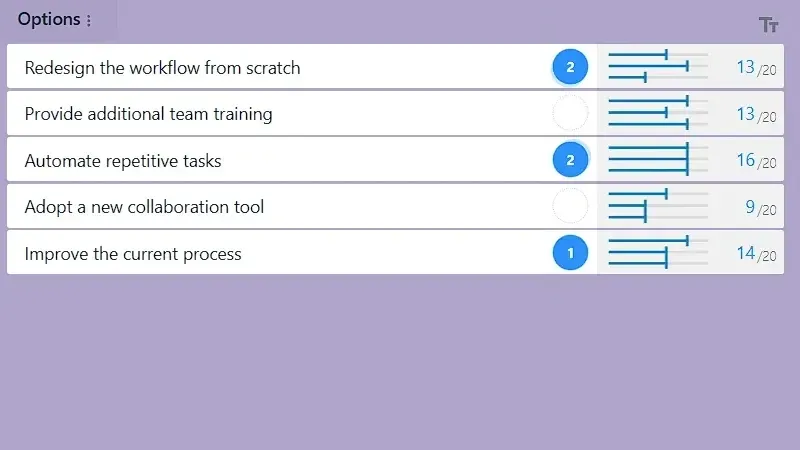
When a decision involves more than a couple of factors, discussion tends to circle the loudest voice or the last point made. A decision matrix fixes this by:
- Making explicit which criteria count, and how much each one matters, before anyone scores.
- Separating the options from the people who proposed them, which reduces bias.
- Producing a single, comparable total for each option that is easy to explain to stakeholders.
- Showing exactly why one option wins, so the reasoning survives after the meeting.
Who should use a decision matrix?
Any team facing a choice with several credible options and multiple trade-offs: product teams picking what to build, operations teams selecting a vendor, hiring panels comparing candidates, or leadership teams choosing between strategic bets. It is equally useful for an individual who wants to think a decision through methodically.
How a weighted decision matrix works
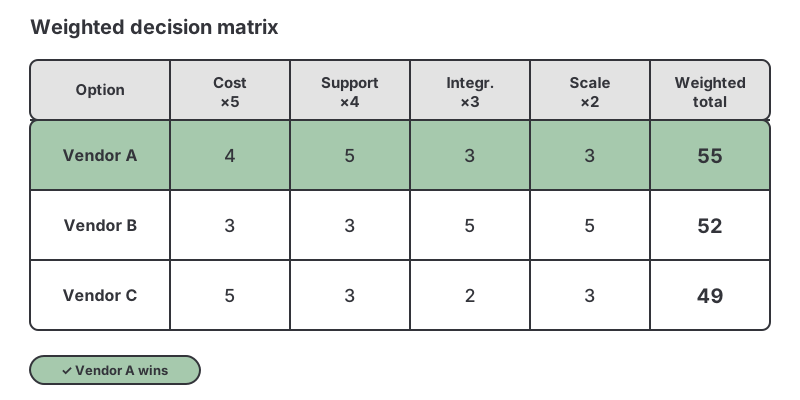
The mechanics are simple:
- List the options you are comparing as rows.
- Choose the criteria that matter and place them as columns.
- Weight each criterion (for example 1–5) to reflect its importance.
- Score each option against each criterion on a consistent scale (for example 1–5).
- Multiply each score by its criterion weight and sum each row.
- The highest weighted total is your leading option.
| Criterion (weight) | Vendor A | Vendor B | Vendor C |
|---|---|---|---|
| Cost (5) | 4 → 20 | 3 → 15 | 5 → 25 |
| Support (4) | 5 → 20 | 3 → 12 | 3 → 12 |
| Integration (3) | 3 → 9 | 5 → 15 | 2 → 6 |
| Scalability (2) | 3 → 6 | 5 → 10 | 3 → 6 |
| Weighted total | 55 | 52 | 49 |
Decision matrix example
Imagine a team choosing a project-management tool. They agree four criteria and weight them: cost is critical (weight 5), support matters (4), existing integrations help (3), and scalability is a nice-to-have (2). Each vendor is scored 1–5 on every criterion.
Vendor C looks cheapest on a raw glance, but once support and integration are weighted in, Vendor A comes out ahead with a total of 55. The matrix makes the trade-off visible: the team is knowingly paying a little more for stronger support and a smoother rollout, and can defend that choice to their sponsor.
The value is not the number itself. It is that everyone can see how it was reached and argue with the weights or scores rather than with each other.
How to run a decision matrix in GroupMap
GroupMap lets a group build the matrix together in real time. Set the decision and the options, agree the criteria and their weights, then have everyone score independently so no one anchors on the first opinion. GroupMap aggregates the scores and calculates the weighted totals live, and outlying scores become the prompt for the most useful conversations. Once the group agrees, capture the decision and the follow-up actions in the same place.
Limitations of a decision matrix
A decision matrix is a thinking aid, not an oracle. Its result depends entirely on the criteria you pick, the weights you assign, and the scores you give. Change any of those and the winner can change. It also assumes criteria are independent and that a higher total is always better, which is not always true. Treat a close result as a signal to discuss, not as a tie to be broken by a decimal point.
Related templates
References
- Decision matrix: American Society for Quality (ASQ)
- Pugh, S. (1991), Total Design: origin of the Pugh controlled convergence matrix
Make better decisions together with GroupMap
GroupMap is more than an online whiteboard: it is built to raise the quality of a group’s decisions. Independent scoring prevents anchoring and groupthink, live aggregation removes the spreadsheet wrangling, and the whole matrix stays visible so the reasoning is transparent. Whether your team is in one room or spread across time zones, a shared decision matrix keeps everyone focused on the criteria and moving toward an agreed, defensible choice.
Frequently asked questions
What is a decision matrix?
How do you make a weighted decision matrix?
What is the difference between a decision matrix and a Pugh matrix?
When should you use a decision matrix?
What are the limitations of a decision matrix?
How to run it in GroupMap

Objective
Frame the decision to be made and list the options you are comparing so everyone scores against the same shortlist.

Brainstorm
Agree the criteria that matter for this decision and set a weight for each so the important factors carry more influence.

Rate
Everyone scores each option against every criterion; GroupMap multiplies each score by its weight and totals it live.

Results
Compare the weighted totals, discuss any close calls, and turn the winning option into agreed next actions.
Ready to get everyone on the same page?
Start a free GroupMap and turn your next discussion into clear, shared decisions.