Team Charter
A team charter sets a team's purpose, values, roles, working agreements and success measures. See a worked example and build yours with our template.
What is a team charter?
A team charter is a shared agreement that sets out why a team exists and how it will work together, usually captured on a single canvas covering purpose, values, roles, working agreements, and success measures. It is created by the team, for the team, and acts as the reference point everyone returns to when priorities or behaviors drift.
Building a charter early gives a new or reforming team a common understanding before the work starts. Instead of assuming everyone shares the same picture of the goal, the roles, and the rules of engagement, you make them explicit and agree them out loud.
Key takeaways
- A team charter defines a team’s purpose and how it will work together.
- Core sections: purpose, values, roles, working agreements, success measures.
- The whole team should build it together so everyone commits to it.
- It is most valuable when a team forms, reforms, or changes direction.
- Treat it as a living document and revisit it as the team evolves.
Why use a team charter?
A team charter is a simple tool that helps a team:
- Align on a shared purpose so effort points in one direction.
- Make roles and responsibilities explicit, reducing overlap and gaps.
- Agree working agreements up front, so friction is designed out rather than fought over later.
- Define what success looks like, giving the team a clear target.
- Onboard new members quickly, because the “how we work” is written down.
Who should use a team charter?
Any team benefits, but charters are especially valuable for newly formed teams, cross-functional project teams, and teams that have grown or changed and lost their shared understanding. They suit team leads and scrum masters setting a team up for success, and any group experiencing friction over unclear roles or expectations.
A charter works only if the team owns it. It should be built collaboratively, in a session where everyone contributes and the wording is agreed together, not handed down as a policy document.
Team charter sections
A typical team charter canvas has five sections:
| Section | It answers | Examples |
|---|---|---|
| Purpose | Why does this team exist? | ”Ship a reliable payments experience customers trust.” |
| Values | What do we stand for? | Transparency, ownership, kindness, quality first |
| Roles & responsibilities | Who does what? | Product lead, tech lead, on-call rotation, decision owners |
| Working agreements | How do we work together? | Daily standup at 9:30, decisions by consent, respond within a day |
| Success measures | How do we know we’re winning? | On-time delivery, low defect rate, healthy team survey scores |
Worked example: a new cross-functional product squad
A newly assembled squad of engineers, a designer and a product manager runs a charter session in their first week:
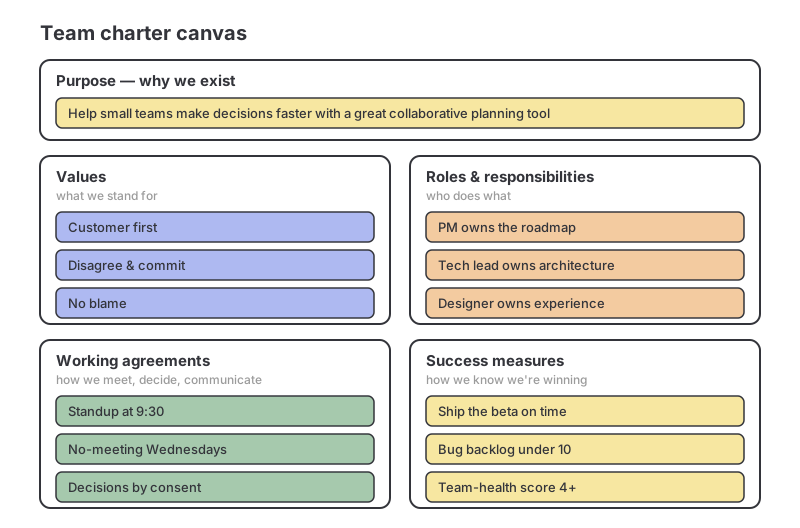
- Purpose: “Help small teams make decisions faster by shipping a great collaborative planning tool.”
- Values: Customer first, disagree and commit, no blame, done over perfect.
- Roles: PM owns the roadmap, tech lead owns architecture, designer owns the experience, the whole squad owns quality.
- Working agreements: Standup at 9:30, no meetings on Wednesdays, decisions default to the owner but anyone can call for a group decision, assume good intent.
- Success measures: Deliver the beta by the agreed date, keep the bug backlog under ten, and score 4+ on the team-health survey.
Written down and agreed together, the charter becomes the squad’s contract with itself, something they can point to when a disagreement or a new joiner needs grounding.
How to run a team charter in GroupMap
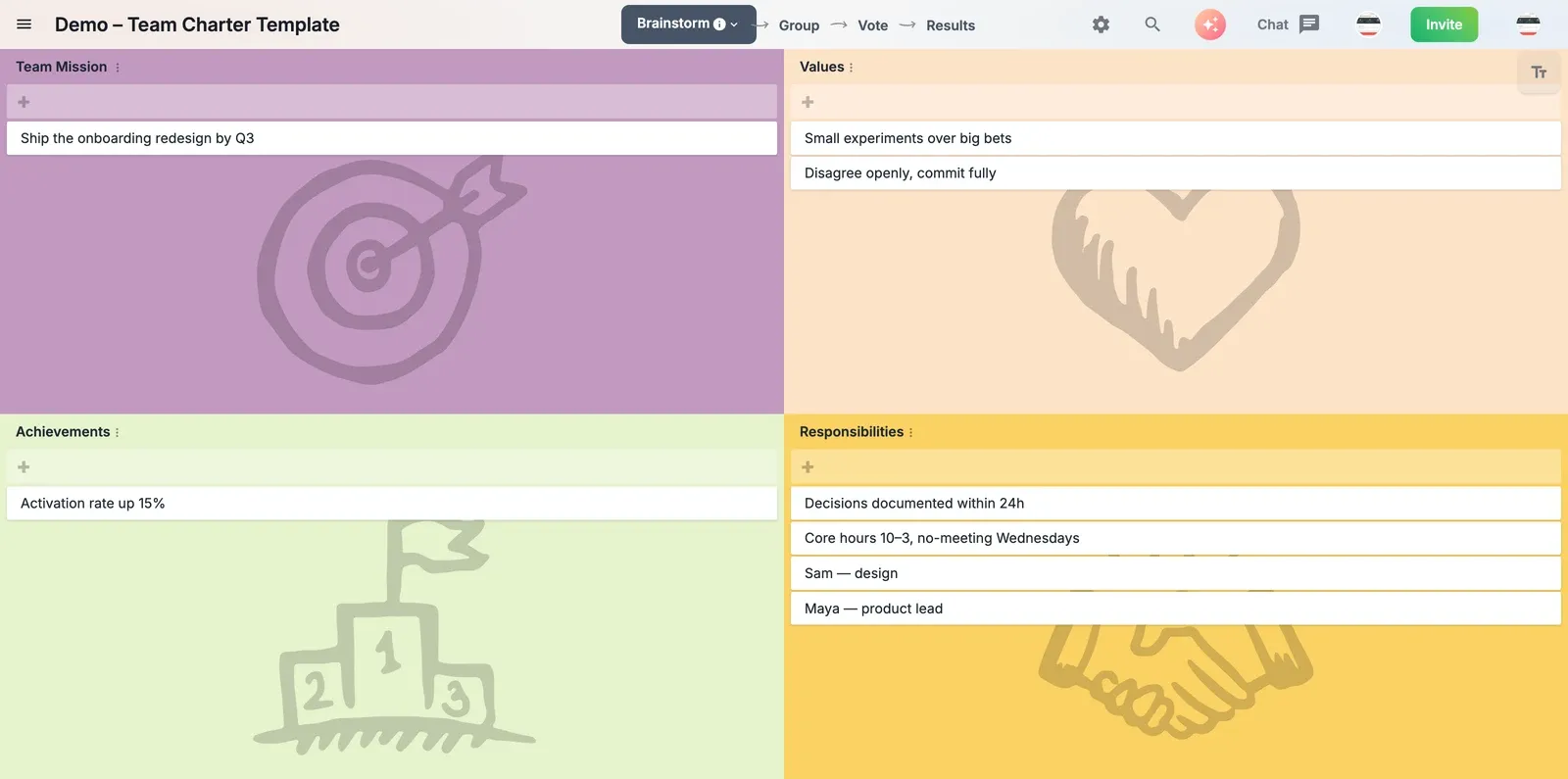
GroupMap’s ready-made Team Charter Template gives you four sections: Team Mission, Values, Achievements and Responsibilities. Invite the team in with a link or password and everyone adds their ideas under each section at the same time, so you capture every voice, not just the loudest. Roles and working agreements both sit naturally under Responsibilities, and your success measures under Achievements.
Then group similar contributions, discuss, and converge on the wording the team can commit to. Because it is built live and together, people own the result. Capture any follow-ups as actions, share the finished charter, and revisit it as the team grows or its goals change.
Limitations of a team charter
A charter helps a team align, but it is not a fix-all. Keep these limits in mind:
- A charter that is written once and never revisited quickly becomes irrelevant.
- It sets intentions, not behavior; the team still has to live the agreements.
- If it is imposed rather than co-created, people ignore it.
- Too much detail makes it a document nobody reads; keep it to roughly one page.
Related templates
References
Set your team up for success with GroupMap
A team charter works best when it is created by everyone and stays visible. GroupMap lets the whole team contribute to each section at once, group and discuss the ideas live, and agree the wording together, so the charter genuinely belongs to the team. Kept as a living reference and revisited as the team changes, it becomes the shared agreement people actually use, not a document that gets filed and forgotten.
Frequently asked questions
What is a team charter?
What should a team charter include?
What is the difference between a team charter and a team canvas?
Who should create a team charter?
When should you use a team charter?
How to run it in GroupMap

Objective
Frame why the team exists and what this charter needs to cover, so the group works to a shared purpose.

Brainstorm
Everyone adds ideas under each charter section: purpose, values, roles, working agreements and success measures.

Group
Cluster similar contributions and discuss to converge on the wording the whole team can commit to.

Results
Agree the final charter, then share it as a living reference the team returns to.
Ready to get everyone on the same page?
Start a free GroupMap and turn your next discussion into clear, shared decisions.