3Cs Framework
The 3Cs framework (Company, Customers, Competitors) finds the strategic sweet spot where you meet customer needs better than rivals. See an example.
What is the 3Cs framework?
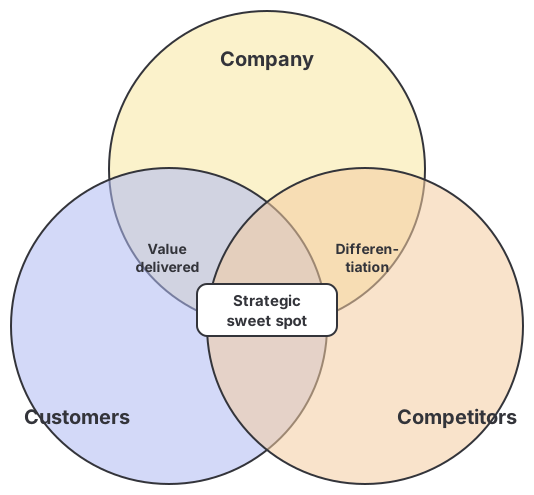
The 3Cs framework is a strategic model that examines three key players (Company, Customers and Competitors) to find a position where a business can satisfy customer needs better than its rivals. Developed by Kenichi Ohmae, it is often drawn as three overlapping circles, with successful strategy living where all three meet.
Ohmae, a McKinsey consultant, introduced the model in his 1982 book The Mind of the Strategist and called it the strategic triangle. Its logic is simple but powerful: a strategy only works if it plays to the company’s strengths, meets genuine customer needs, and does so in a way competitors cannot easily copy. Miss any one C and the strategy is exposed.
Key takeaways
- The 3Cs are Company, Customers and Competitors: Ohmae’s “strategic triangle”.
- Winning strategy sits in the overlap: your strengths meeting real customer needs, ahead of rivals.
- It was set out by Kenichi Ohmae in The Mind of the Strategist (1982).
- It is more focused than the 5C analysis, which adds Collaborators and Climate.
- It is best run as a group so each C reflects real, cross-functional knowledge.
The three Cs explained
| C | Key questions |
|---|---|
| Company | What are our strengths, resources, capabilities and objectives? Where can we genuinely excel? |
| Customers | Who are our segments? What do they actually need, value and do? How is that changing? |
| Competitors | Who else serves these customers? How are they positioned, and where are they strong or weak? |
Strategy is about the overlaps:
- Company ∩ Customers is the value you deliver: where your strengths match what customers need.
- Company ∩ Competitors is your differentiation: where you can outperform rivals.
- Customers ∩ Competitors is the battleground: needs everyone is chasing.
- The center is the strategic sweet spot: needs you can meet, that customers want, and that competitors cannot match as well.
Why use the 3Cs framework?
- It keeps strategy customer-centric while staying honest about your own capabilities and the competition.
- Its simplicity makes it fast: a strong lens for a focused product, market or positioning decision.
- The overlap view pinpoints where genuine, defensible advantage can be built.
- It is easy to communicate: three circles everyone in the room can reason about together.
Who should use the 3Cs framework?
The 3Cs suits founders, marketers, product managers and strategy teams shaping positioning, entering a market, or launching a product. It is especially useful early in planning, when a team needs a clear, shared view of where it can win before diving into detailed tactics. For a wider environmental scan, extend it into a situational analysis or add a PEST view.
3Cs framework example
A startup building a project-management app for creative agencies works through the triangle:
- Company: a small, design-led team that ships fast and understands agency workflows deeply; limited sales and marketing budget.
- Customers: creative agencies frustrated by generic tools that ignore how they scope, review and bill creative work.
- Competitors: large horizontal players (feature-rich but generic) and cheap all-purpose tools (simple but shallow).
The sweet spot: a focused, beautifully designed tool built specifically around agency workflows, playing to the company’s design strength and workflow knowledge, meeting an unmet customer need, and sidestepping the generalist competitors head-on. That becomes the positioning.
How to run a 3Cs analysis in GroupMap
The 3Cs get sharper when sales, product, marketing and leadership each bring their view, so run it as a group.
- Set the objective. Name the positioning, product or market decision you are making.
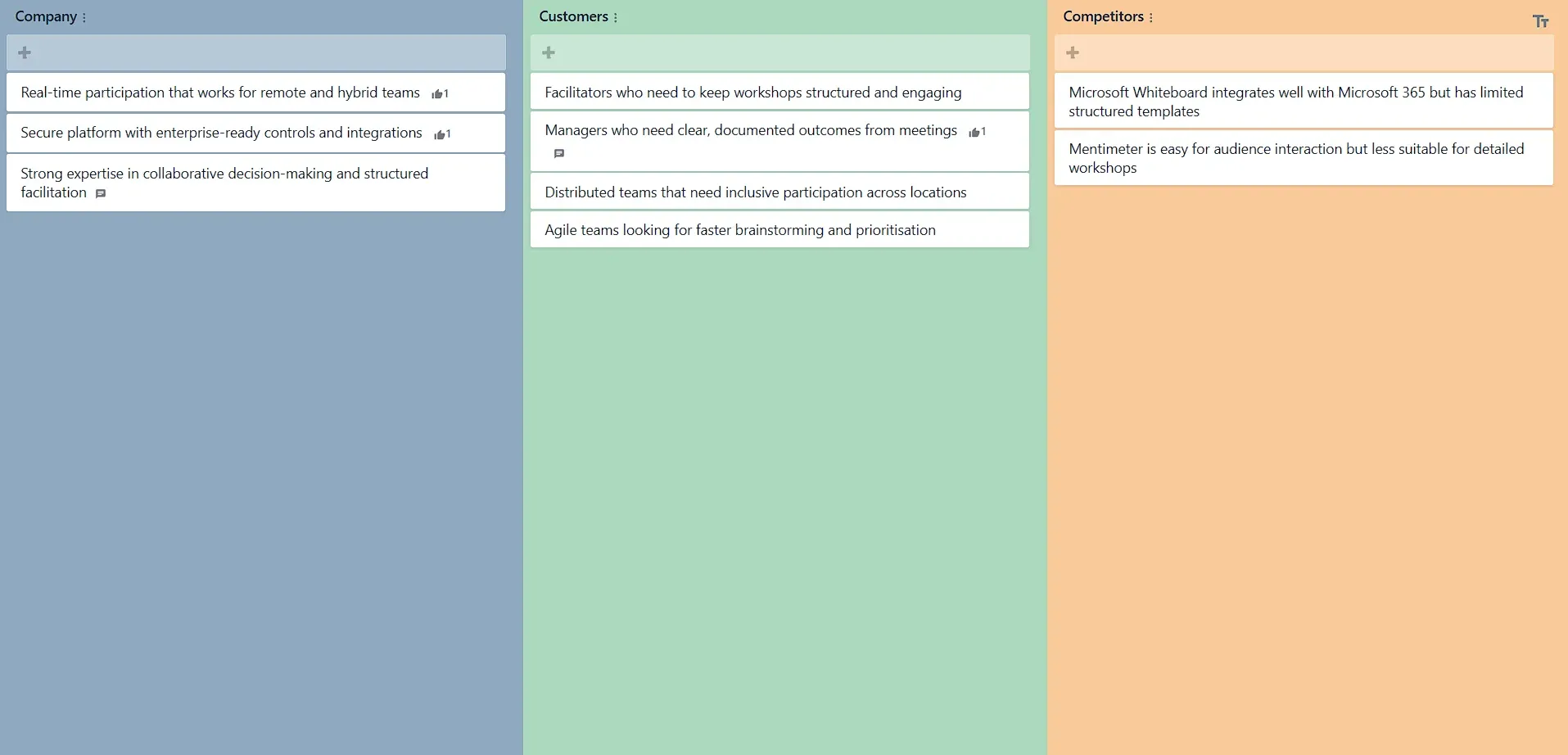
- Fill each circle. Everyone adds insights under Company, Customers and Competitors.
- Group within each C. Cluster related points so the strongest themes stand out.
- Explore the overlaps. Discuss value (Company ∩ Customers) and differentiation (Company ∩ Competitors).
- Locate the sweet spot. Agree where you can meet a real need better than rivals.
- Agree actions and share. Translate the sweet spot into positioning and next steps, then distribute.
Limitations of the 3Cs framework
- It omits collaborators (partners, suppliers, channels) and the macro-environment, so it can miss key forces.
- It is qualitative and depends on the honesty and quality of the inputs.
- It is a snapshot: customer needs and competitor moves shift, so revisit it.
- For a fuller picture, pair it with a PEST analysis or a 5C situational analysis.
Related templates
- Strategy frameworks
- Situational analysis
- SWOT analysis
- PEST analysis
- Perceptual map
- Business model canvas
References
Find your sweet spot with GroupMap
The 3Cs framework works best when each circle is filled by the people closest to it, and GroupMap brings them together on one board. Sales speaks to customers, product to company strengths, and marketing to competitors, all at once, then the group explores the overlaps live to agree where it can win. Private input reduces groupthink and customizable workflows keep the session focused on turning the strategic triangle into a clear, shared position.
Frequently asked questions
What is the 3Cs framework?
Who created the 3Cs model?
What are the three Cs?
How is the 3Cs framework different from the 5Cs?
What are the limitations of the 3Cs framework?
How to run it in GroupMap

Objective
Frame the strategic question (a product, market or positioning decision) the 3Cs analysis will inform.

Brainstorm
Gather insights under each C: the company's strengths, customer needs and segments, and competitor positions.

Group
Cluster related points within each circle so the overlaps and gaps between the three Cs become clear.

Results
Agree where the strategic sweet spot lies, then share the positioning and actions with stakeholders.

Action
Agree the moves that follow from the sweet spot, with an owner and a date against each one.
Ready to get everyone on the same page?
Start a free GroupMap and turn your next discussion into clear, shared decisions.