Ansoff Matrix
The Ansoff Matrix helps you strategies for future product growth, considering the market and product direction. Get started with our Ansoff Matrix Template.
What is Ansoff Matrix?
The Ansoff matrix (aka Ansoff model – four ways to grow), developed by H. Igor Ansoff, is a fantastic tool to plan product-market strategy, contributing to the growth and future success of your organization.
Quickly and easily invite your team and get all your strategies down fast. The Ansoff matrix gives you the structure to decide on which growth strategies work for your organization now.
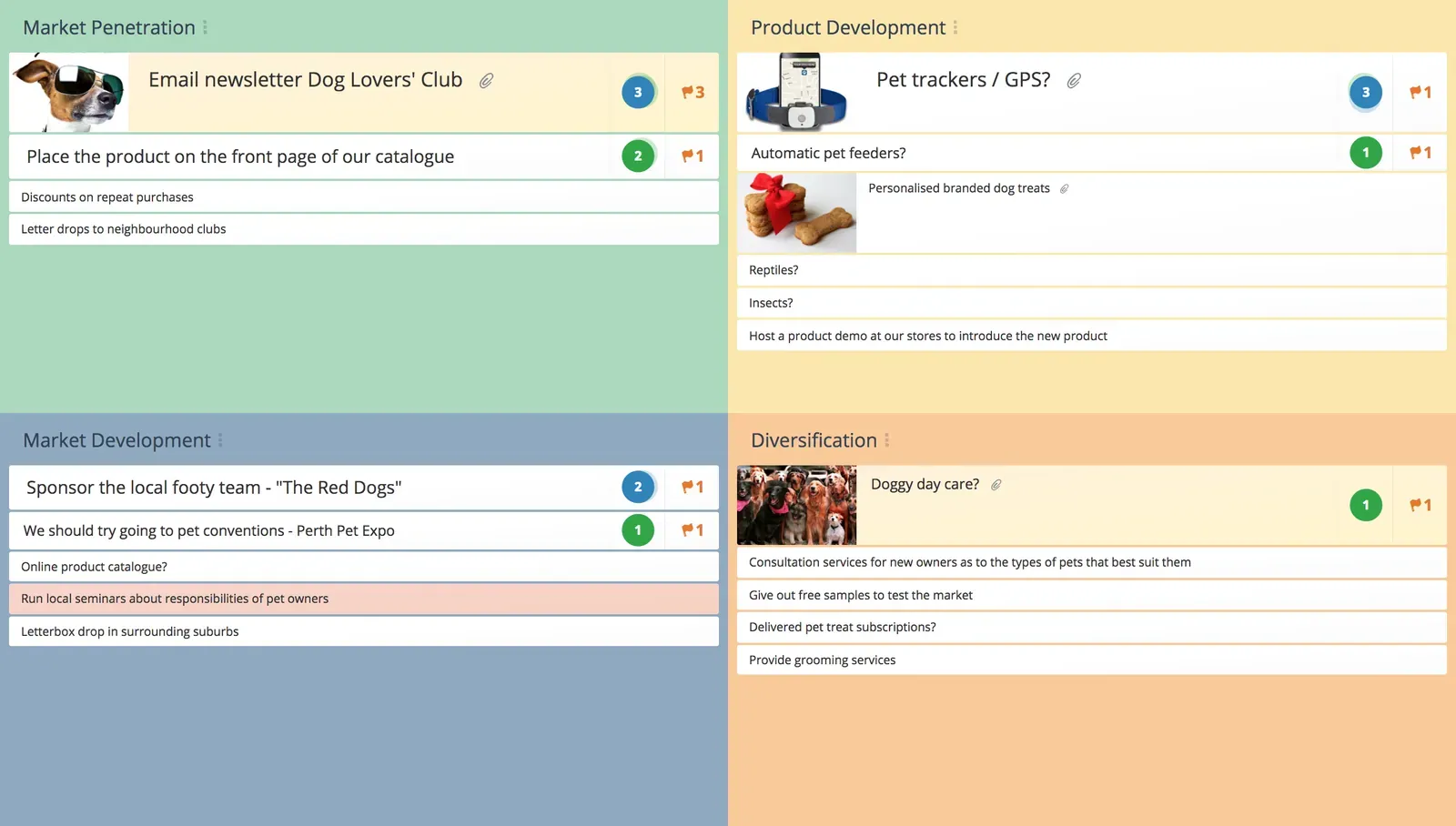
How to use Ansoff Matrix?
The Ansoff matrix provides an easy to follow framework for teams to explore how different products and services fit into the organization’s growth strategy. It comprises of four quadrants that help you to grow and scale your business. Each quadrants suggests a potential growth strategy, and also an associated risk.
The 4 quadrants are Market Penetration, Product Development, Market Development and Diversification. As you discuss each section with the team, it encourages ideas for potential changes or opportunities in each of those quadrants. Generally speaking, this activity is run once a year, though this can be more regular during rapid industry changes or there is a strong need for innovation.
Market penetration
Existing Markets / Existing Products
Growth is achieved using existing products in existing markets. This means selling at higher volumes, or finding new channels in the existing market.
This generally has the least risk because it is a known market and the goal is to focus on boosting sales of your product into the existing market.
This requires you to be aware of the strengths and weaknesses relative to the competition. This is generally a low risk category because there is a known history, prior data and it may be easier to identify what is already working well or not.
Market development
New Markets / Existing Products
Growth is achieved by taking existing products into new markets. Examples include selling to different customer segments, selling a consumer product to industry, or entering foreign markets.
This is a medium to high risk to high risk category depending on the capabilities for the organization.
This option looks to expand the existing product but can introduce additional customization, ensuring a use case for the product in the new market as well as understanding the psychology and demographics of a new market place.
Product development
Existing Markets / New Products
Growth is achieved by creating new products for an existing market. This may involve researching and developing a new product to meet unfilled needs of the current customer base.
There would be considered a medium to high risk category. While it may be easier to reach current customers or to understand their current problems, there is product and fit-to-market risk associated with coming up with a new product or service to solve that need.
This requires up-selling, innovation and ensuring there is alignment between the new product or service with the customer’s needs.
Diversification
New Markets / New Products
Growth is achieved by creating new products or services for new markets and represents additional product lines for new profiles of customers.
This would be the highest risk category. This usually stems from an organization having existing resource and capabilities and who want to create new revenue or investment streams.
This would require them to redirect resources and time away from their current core activities. The opportunity allows the organization to play in a new vertical but has the highest level of uncertainty.
How to run Ansoff Matrix workshop
The time required to construct a Product-Market matrix depends on the organization, the size of the group, and the objectives of the session. However, there is no reason why you can’t brainstorm, prioritize, and develop a consolidated action plan in less than an hour.
All Ansoff matrix workshops should begin by stating the objective of the session and ensuring all participants are clear on the scope so they can focus their efforts. Define the objective before the actual workshop to save time.
Ask your participants to populate the map under each heading. e.g. If the company normally supplies chocolates for teenagers, they may wish to take an existing product line and rebrand it for the adult market under Market Development.
Different methods for gathering input and ideas from participants include a whiteboard, post-it notes, or on dedicated software like GroupMap.
Review each of the quadrants in turn – prioritizing each of the product ideas by sorting them in order of likely value. You can do this as a team (collaborative) or individually. Positioning ideas individually will allow you to see whether there is consensus in the room.
You may also use dot voting to narrow down the top strategies by asking the team to discuss and vote on the strategies they believe will have the biggest impact for the organization.
For each priority strategy, there should be one or more actions. Assign responsibility and a timeframe for completion to a group or individual.
Sharing and communicating the outcomes of the Ansoff Matrix and subsequent action plan are essential to getting buy in from participants and other stakeholders. Use the completed Ansoff’s Matrix to help align your teams focus and energies across each of the strategies.
GroupMap automatically generates visually appealing reports in several formats for distribution, saving time and effort after the workshop.
Related templates
References

Save effort, time and money with GroupMap
GroupMap offers more than just an online digital whiteboard. Its innovative platform is designed to enhance the quality of your team’s decisions. With features that prevent bias and keep facilitation simple, GroupMap makes sure no single voice dominates and keeps conversations productive and inclusive. Its intuitive interface is easy for anyone to use, and its scalable design supports small teams and large groups whether they are face to face or around the globe. Customizable templates and workflows keep discussions focused on objectives, helping you drive actionable outcomes each and every time.
Frequently asked questions
What is the Ansoff Matrix?
What are the four quadrants of the Ansoff Matrix?
Which Ansoff strategy carries the most and least risk?
Who developed the Ansoff Matrix?
How often should you use the Ansoff Matrix?
How to run it in GroupMap

Objectives
Define a clear, one sentence objective for the Ansoff matrix.

Brainstorm
Gather input and ideas.

Position
Review each of the products and position them in the correct quadrant, in priority order.

Action planning
Identify action items for the highest top products in each quadrant. Create an action plan and assign responsibility for each issue to a group or individual for action.

Share and communicate
Share and communicate the outcomes of the session, including the action plan to relevant stakeholders.
Ready to get everyone on the same page?
Start a free GroupMap and turn your next discussion into clear, shared decisions.