Force Field Analysis
Force Field Analysis, Kurt Lewin's change model, maps the driving and restraining forces behind a decision. Run one live with your team using our template.
What is a Force Field Analysis?
Force Field Analysis is a tool that helps a change practitioner to visually map and analyze the driving and resisting forces behind a project, a decision or initiative. A Force Field Analysis does this identifying two forces that are arranged as opposing forces or as a “force field.” These two forces are driving forces (those that are working in the direction of the change) and resisting and/or restraining forces (those that tend to support the status quo).
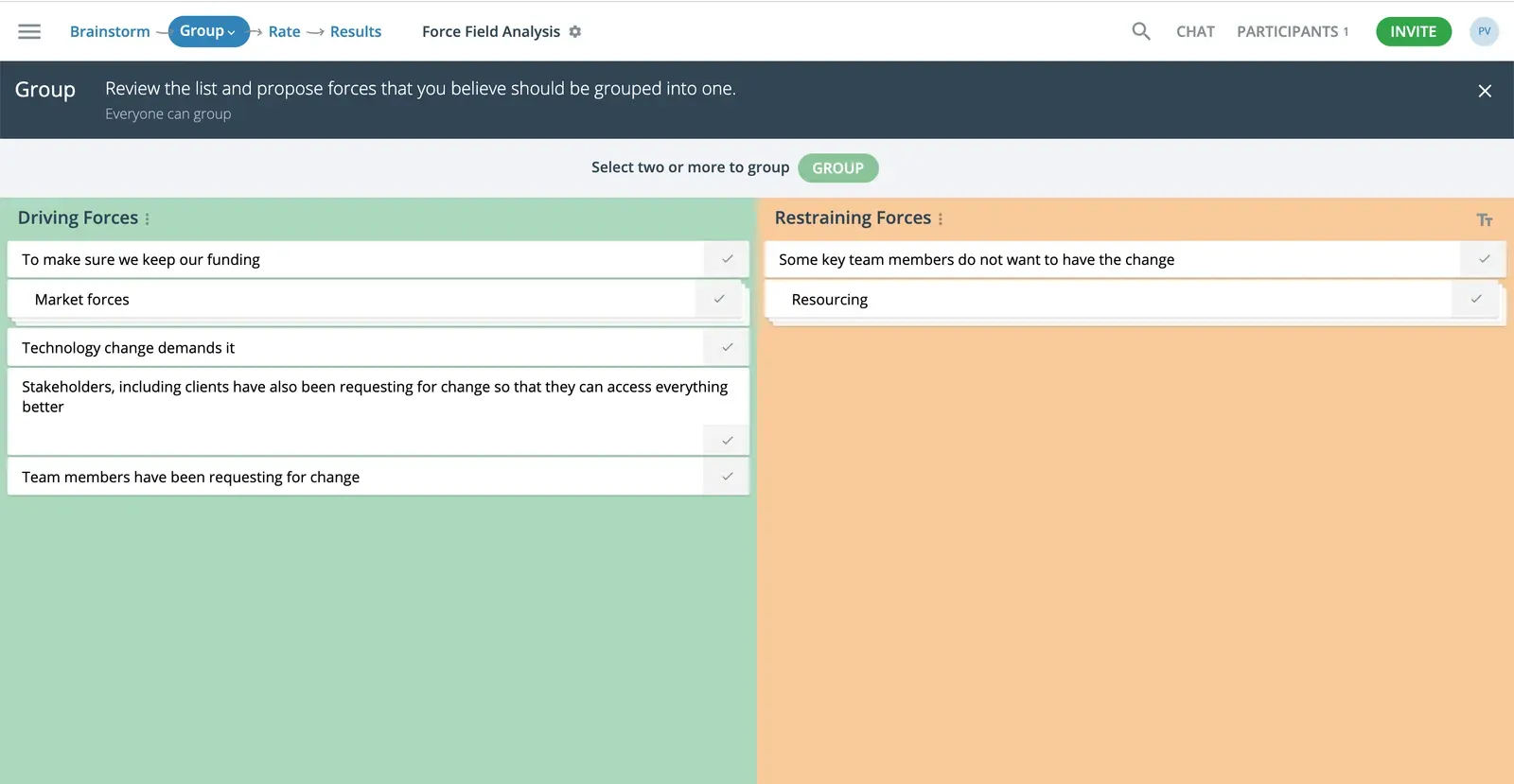
Force Field Analysis is a powerful decision-making tool that was originally developed by Kurt Lewin in 1951. Today, the Force Field Analysis model is still used by many organizations for supporting change processes.
The idea behind Force Field Analysis is that situations are maintained by an equilibrium between forces that drive change and others that resist change. So, for change to happen, the driving forces must be strengthened or the resisting forces weakened.
A Force Field Analysis template in GroupMap helps you to visually map and brainstorm, in real time, the driving and resisting forces around decisions to be made.
Why do a Force Field Analysis?
When you are making difficult or challenging decisions, using an effective and structured decision-making technique such as the Force Field Analysis can help to improve the quality of your decisions and increase your chances of success.
Conducting a Force Field Analysis will help you to see the bigger picture, to identify and overcome obstacles and to develop a plan which will significantly increase the likelihood of a successful outcome.
See change management in practice: ComTeam Group used GroupMap to foster success through change.
Tips for effective Force Field Analysis
- The analysis is best carried out in small groups who are directly involved in the change implementation process.
- Change affects everyone so it is important that everyone else who is also likely to be affected by the change is kept in the loop. This will gain everyone’s commitment and support for the change itself.
- Involve everyone affected in the planning, development and decision-making from the very beginning.
- Use anonymity to make sure all team members feel safe when participating around sensitive issues.
Force Field Analysis template
A Force Field Analysis Template provides a visual representation of the driving forces and restraining forces for and against an initiative, a project or change proposal.
Common dimensions used for a Force Field Analysis map include:
Driving forces
What are the creators of change or factors that are driving change to happen or be considered
Examples can include:
Competitive advantage, need for increased productivity, overwhelming customer request, new technologies, internal team requests, new trade or commercial restrictions and requirements, to achieve funding grants & initiatives, etc.
Questions to ask:
- Why do we need to make these changes?
- Who is requesting for this change and why?
Restraining forces
What are the obstacles for change or opposition that is expected to prevent change from happening.
Examples include:
Associated costs for change, opposition from some team members, potential unhappy customers and lost loyalty and revenue, available resources to manage change, time available to make the change/s on time, etc.
Questions to ask:
- What factors will affect us moving forward?
- Who will oppose us moving forward or making changes?
The resulting brainstorm allows for scoring to understand how important the forces are and how to address them in a further action plan or SWOT analysis.
Force Field Analysis example
Imagine a team deciding whether to adopt a new project management tool. Scoring each force from 1 (weak) to 5 (strong) makes the balance easy to see.
Driving forces (for the change)
- Faster reporting and less manual admin (4)
- Better visibility for remote team members (4)
- Requested by several team leads (3)
Restraining forces (against the change)
- Cost of licences and migration (3)
- Time to learn a new tool (4)
- Comfort with the current process (2)
Here the driving forces (11) outweigh the restraining forces (9), so the change looks viable, and the scores show that reducing the learning curve is where to focus first. This example is illustrative; your own scores come from the group discussion.
How to do a Force Field Analysis
Assemble a small group – between 5 – 9 people – who are directly involved in the change implementation process.
The time taken will depend on the organization, the complexity of the forces, the number of people involved, amongst other things.
Tip At the end of the analysis, it is expected that an action plan will be available or is on the list to be developed to progress change for a project or initiative in a successful manner.
Who can use a Force Field Analysis?
Anyone involved in the change implementation process or need to diagnose problems can use the Force Field Analysis. This includes but is not limited to:
- Human Resources
- C level suites / executives
- Teams, departments, sections that are focused on change management
- Change management consultants
Use the Force Field Analysis model to help with:
- Analyzing the balance of power
- Identifying the key roles involved in decision-making
- Identifying who supports and opposes change within the organization
- Exploring ways to influence those who are against change
- Deciding whether to go ahead with a proposed change or not
Related templates
References
- Lewin, Kurt. 1946. “Force Field Analysis.” The 1973 Annual Handbook for Group Facilitators. 111-13.
- Force-field analysis: overview of Lewin’s model and how the driving and restraining forces are weighed.

Save effort, time and money with GroupMap
GroupMap offers more than just an online digital whiteboard. Its innovative platform is designed to enhance the quality of your team’s decisions. With features that prevent bias and keep facilitation simple, GroupMap makes sure no single voice dominates and keeps conversations productive and inclusive. Its intuitive interface is easy for anyone to use, and its scalable design supports small teams and large groups whether they are face to face or around the globe. Customizable templates and workflows keep discussions focused on objectives, helping you drive actionable outcomes each and every time.
Frequently asked questions
What is a Force Field Analysis?
Who developed Force Field Analysis?
What are driving and restraining forces?
What are the advantages and disadvantages of Force Field Analysis?
What is the difference between Force Field Analysis and SWOT analysis?
How to run it in GroupMap

Scope
Assess the current situation of the organization in terms of the issue at hand.

Define
Identify what objectives the team would like to gain from conducting this analysis.

Brainstorm
Together with your group, discuss and list all of the driving and restraining forces.

Score
Evaluate the influence of each force by assigning them scores on a matrix that determines their importance.

Report
Report on the outcomes and share the results of the analysis with the rest of the team or company for good communications.
Ready to get everyone on the same page?
Start a free GroupMap and turn your next discussion into clear, shared decisions.