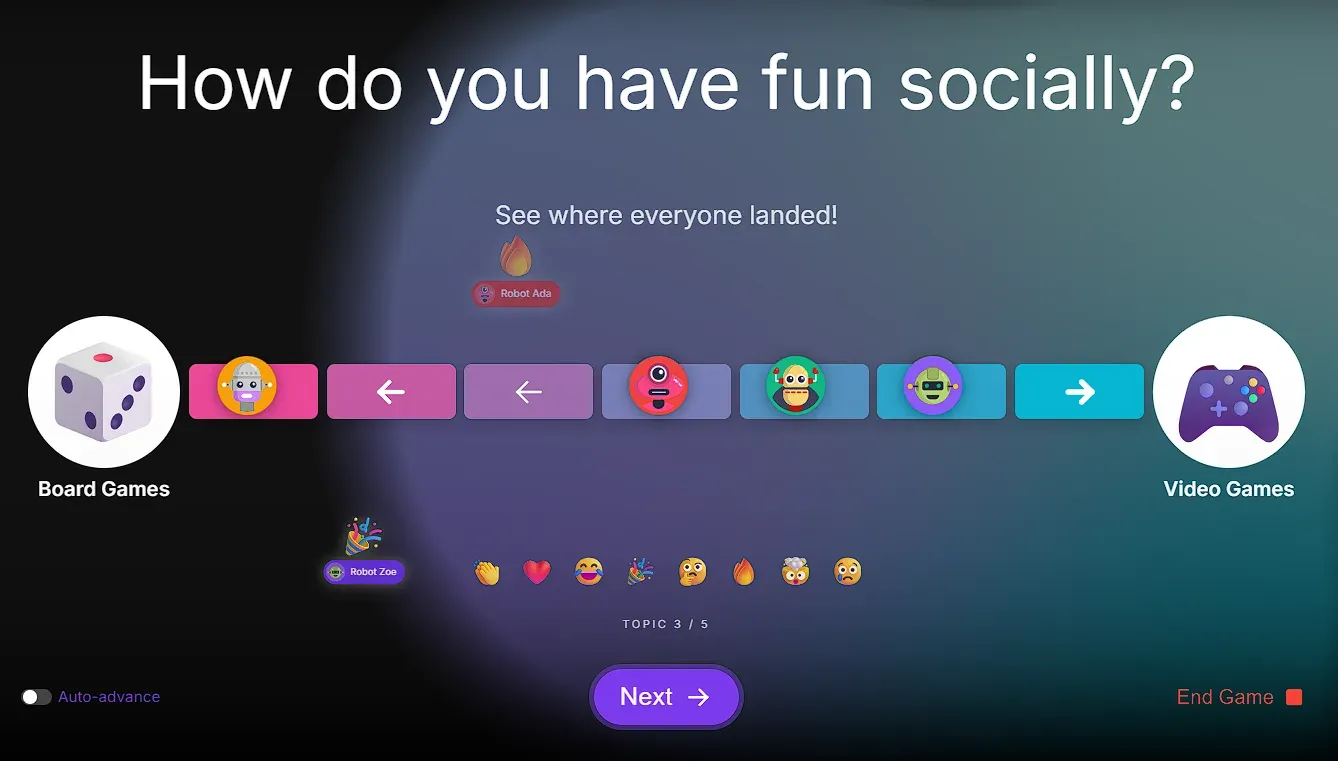
15+ cool icebreaker games you can run at your next meeting
Ready to add energy, get the room moving and talking? Warm up the whole room before you run your agenda with this collection of icebreaker games.
Some of us love starting a meeting with a warm-up or icebreaker activity but doing so usually means stepping outside the tool.
Not anymore. Icebreaker games now run inside GroupMap as an optional step in your meeting, so the warm-up and the work happen in the same place.
Why run icebreaker games in your GroupMap meeting
A warm-up in a separate tool costs more than the minutes it takes. Every context switch sheds participants: someone’s link fails, someone stays in the other tab, and the energy you built evaporates while everyone finds their way back.
Running the opener in the map matters beyond logistics: every participant has already typed, drawn, or guessed, so contributing feels normal. The quieter voices that independent brainstorming protects are warmed up too, not just the confident ones.
Games are now a step in your process
Whether you call them icebreakers, warm-up activities, or energizers, these are now all part of your GroupMap experience.
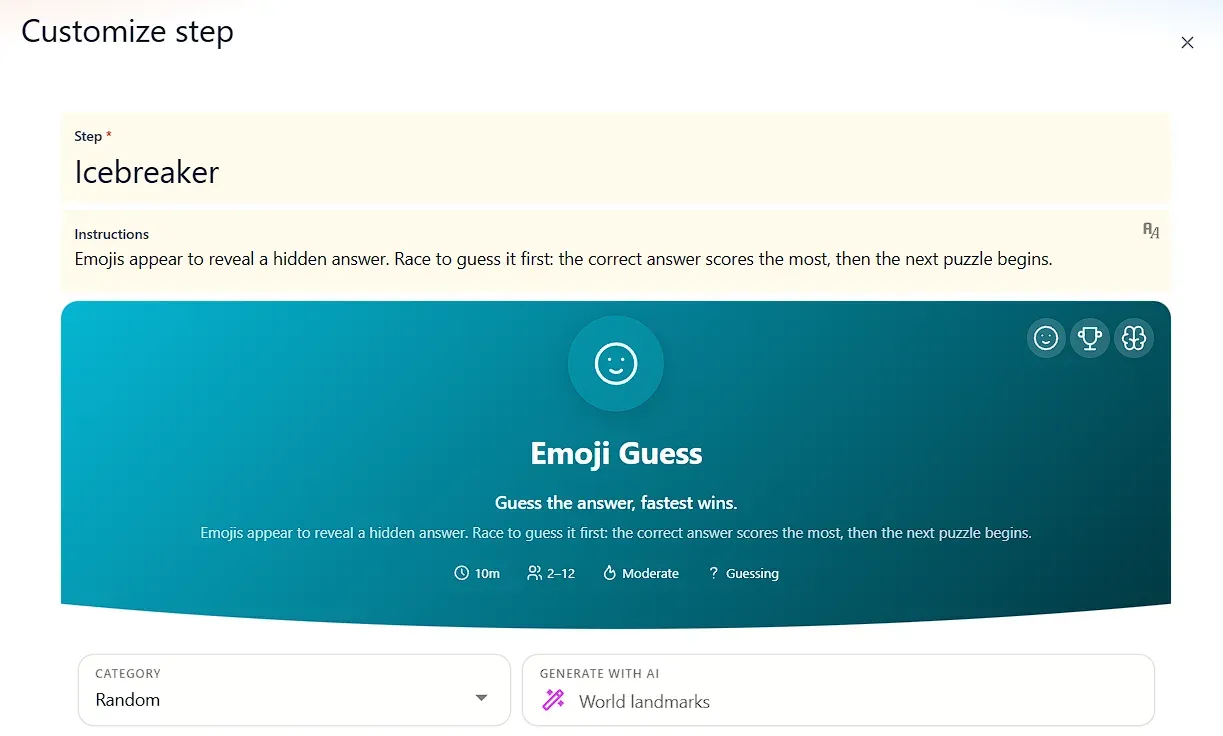
You can simply build it into your process, add it as a step throughout any of your activities, and run it like any other part of your GroupMap session. Participants are already in the map so by the time you enter the icebreaker, the game can start for everyone. Simply customize the step in your map and choose from a library of games. Participants open your map from their own device with a link, so nothing needs to be installed and there’s no second room to admit anyone into.
It is entirely opt-in. The agenda stays yours.
A library built for warming up a room
We’ve already built 15+ (more to come): a series of icebreaker games, from drawing to storytelling to quick quizzes, and other handy utility tools like spinners and finding out where people stand on a topic.
All you have to do is select the category, difficulty, duration, and group size to filter and choose the game you think is best for your audience. Most games have customizable topics, so you can theme them to better match the workshop you’re running.
You can set up most games with customizable options to vary the game and tailor the topic of the icebreaker to your own theme by:
- adding in your own questions
- selecting from a drop-down library
- using our AI generator Atlas to come up with a set of questions that you can then modify as needed.
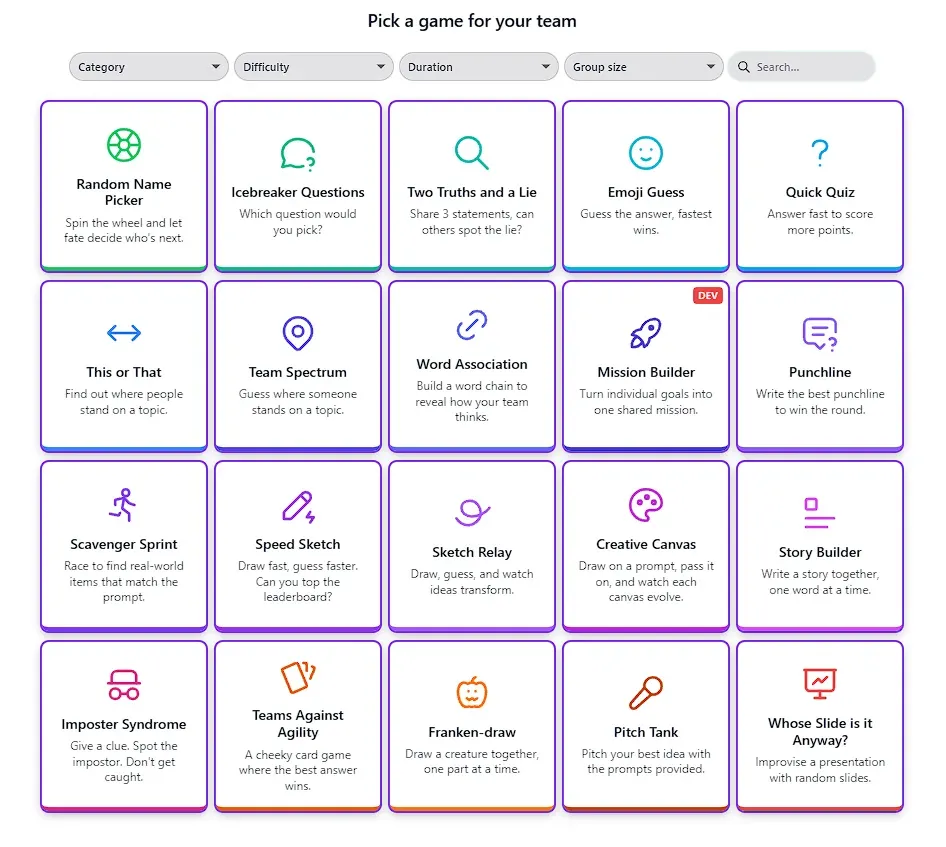
Here’s just a sneak peek of some of the games we’ve already built into GroupMap for you.
| Game | What happens |
|---|---|
| Random Name Picker | Spin the wheel and let fate decide who goes next. |
| Icebreaker Questions | Pick a question for the team to answer together. |
| Two Truths and a Lie | Share three statements and see if the team can spot the lie. |
| Emoji Guess | Work out the answer from a set of emojis. Fastest wins. |
| Quick Quiz | Answer fast to score more points. |
| This or That | Find out where people stand on a topic. |
| Team Spectrum | Guess where someone stands on a topic. |
| Word Association | Build a word chain to reveal how your team thinks. |
| Punchline | Write the best punchline to win the round. |
| Scavenger Sprint | Race to find real-world items that match the prompt. |
You can find the full list of icebreaker games and activities in our help center. Each one has been designed to serve a particular purpose, from simply asking a question through to creative collaboration on the canvas.
Match the game to the activity that follows
A warm-up activity that rehearses what you are about to ask the room to do does double duty: you’re using the icebreaker to get your group into the right frame of mind. Here are some examples of which games to run and why.
- Two Truths and a Lie, for a group meeting for the first time. Each participant shares three statements, and the room spots the lie, so people have said something about themselves before you ask them to agree on how they will work together in a team charter.
- This or That and Team Spectrum, before you prioritize or decide on a set of tasks. This or That asks every participant to commit to a position and see where others landed. Team Spectrum turns that around: the room guesses where someone stands on a topic. Both make the spread of opinion visible before you ask the group to prioritize, the same move as placing ideas on an impact effort matrix.
- Quick Quiz, for training and classroom sessions. A fast scoring activity on a chosen topic surfaces what the room already knows, so a KWL chart gets a kickstart to the process.
- Speed Sketch and Sketch Relay, before creative work. Draw-and-guess rounds get people thinking in pictures and loose associations, which is the mode group mind mapping runs in.
- Story Builder, for quieter rooms. The group writes a story one word at a time, so every participant has already added something small and low-pressure. This can be a useful mental warm-up for a PMI activity.
Which icebreaker game should you pick?
Here’s how to think about it, one factor at a time.
- What’s it actually for. Are you loosening people up before a heavy conversation, or is this the whole point of the first five minutes? In GroupMap this maps to the Category filter, competition, creativity, participation, or thinking. Pick competition or creativity when you want pure energy (Speed Sketch, Emoji Guess, Quick Quiz), and participation or thinking when you want it to double as a soft entry into the real agenda (Icebreaker Questions, Team Spectrum, This or That).
- How comfortable this group already is with each other. This is where GroupMap’s Difficulty rating earns its keep. It’s not about how hard the game is to play, it’s about how much it asks participants to expose. New or mixed teams do better with low-difficulty options like Random Name Picker, Emoji Guess, or This or That. Teams who’ve been through a few sessions together can handle Two Truths and a Lie, Imposter Syndrome, or Whose Slide is it Anyway, where there’s real performance and vulnerability involved.
- How much time you genuinely have. Duration should be added to your meeting length, not carved out of it. If your icebreaker eats into the agenda you were trying to warm people up for, you’ve made the room’s problem worse, not better.
- How many people you’re running this for. Group size matters, but so does whether the game is turn-based or simultaneous. Word Association, Story Builder, and Franken-draw build on each other one person at a time, which starts to drag once you’re past a certain headcount. Quick Quiz, Emoji Guess, This or That, and Speed Sketch have everyone acting at once, so they hold up fine in a bigger group.
- Where everyone’s actually joining from. A game like Whose Slide is it Anyway or Pitch Tank needs cameras on and a bit of performance energy, which works well in person or on video but falls flat on an audio-only call. Scavenger Sprint needs people to grab real objects, which is oddly easier remote, where everyone’s sitting at their own desk, than in a bare meeting room.
- Whether it should connect back to the session itself. Most games let you load in pre-made or AI-generated topic categories. That’s your chance to make the icebreaker actually about the workshop or planning session you’re heading into, rather than something totally disconnected from the work.
- How confident you are running it. Every game in the library is pre-built, so prep time isn’t really the variable, your own familiarity is. Run Practice with Robots before the session so you’re not learning the mechanics live in front of your team.
- Whether your team has already done it. If you’ve run an icebreaker several times before, you might want to try something new to keep it fresh. Rotate through the library. Novelty does real work for engagement, even in a five-minute warm-up.
- How much you’re asking people to put themselves out there. This sits next to difficulty but is worth naming on its own, games with a performance or spotlight element (Pitch Tank, Punchline, Whose Slide is it Anyway) are great for a confident, established team and genuinely risky for quieter or more junior participants. Know who’s in the room before you pick one of these.
- What kind of energy do you want people carrying into the next phase. A fast, competitive game leaves a room buzzy and a bit loud. A slower, thinking-category game leaves people more reflective. Choose the one that sets up the meeting that follows, not just the one that’s most fun in isolation.
Looking for more icebreaker ideas?
If you prefer to run your own opener, our icebreaker and warm-up templates including options that scale to large groups are still there. Use these to create your own versions of icebreaker activities.
Try one in your next session. Start your 14-day free trial, or contact us if you’d like a walkthrough.
Related posts
 January 2, 2025Want to save time in 2026? Try these meeting alternatives
Cut calendar clutter in 2026 with alternatives to meetings: async updates, decision docs, office hours and AI summaries to keep work moving.
 April 14, 2022Creating a psychologically safe space for better collaboration
We define psychological safety (what it is and what it isn't), then explore why it matters and how it strengthens team collaboration.
 January 25, 20225 great ground rules for effective meetings
We share our 5 best ground rules to help you deliver more effective meetings.
Ready to get everyone on the same page?
Start a free GroupMap and turn your next discussion into clear, shared decisions.