Icebreakers and warm-ups
Four ready-to-run icebreaker templates, plus how to pick one for the session you are facilitating, how long to give it, and what to do when nobody answers.
Why use an icebreaker?
Icebreakers are a great tool for launching collaborative sessions. They open the channels of communication, and help put people at ease by giving everyone a chance to contribute.
Start a fun icebreaker in GroupMapThe value of icebreakers doesn’t stop there. They help set the tone for a session. They let the facilitator model collaborative behavior. They can also establish common ground between participants which helps foster spaces in which people are happy to share.
A good icebreaker should be so simple that people can respond almost instantly. They aim to get a response rather than a right answer. Icebreakers should be inclusive. They should apply to everyone in the group so they all get the chance to contribute positively.
Everything that’s said during an icebreaker can help build a connection. That’s why asking people to explain their input is giving them a chance to connect. The best thing about these new connections is that they start a conversational momentum that carries over into the session itself.
In short, icebreakers help focus and engage a group to ensure they get the most out of their collaborative session.
Choose an icebreaker for your session
The activity matters less than the fit. Three things decide which icebreaker belongs at the top of your agenda:
| If the room is… | Run something that… | Start with |
|---|---|---|
| Meeting for the first time | Needs no shared history to answer | Photo Wall or Where in the World |
| A group that already works together | Surfaces how people arrived today | Mood Wall or a one-word check-in |
| About to do something contentious | Agrees how you will work before you start | House Rules |
| Larger than about 30 people | Lets everyone answer at once, not in turn | Icebreakers for large groups |
| Remote or hybrid | Makes contributions visible on a shared board | Where in the World or Photo Wall |
Two rules of thumb behind the table. Pitch the disclosure to the room. A prompt that a standing team enjoys can feel intrusive to a group of strangers, and the safe direction is always to ask less. And watch the headcount: any icebreaker that takes turns costs about 30 seconds per person, so the same activity that charms a room of 12 quietly consumes half an hour in a room of 60.
Our icebreaker templates to help build connections
Our team has hand-picked our top four fun icebreaker activities and designed templates to deliver them online.
-
House Rules Create a safe conversational space where a set of agreed rules can be agreed upon.
-
Photo Wall A colorful, creative collage that lets participants share a friendly fact or two about themselves by way of some conversation starter questions.
-
Two Truths and One Lie A fun and creative way to have participants interact with each other while discovering a fact each is happy to share.
-
Where in the World? A way for people to share a bit of where they are located or where they are from and perhaps to learn something about the area.
You can find these templates in our library of meeting templates and maps. And if you would rather pick a ready-made game than run a template, there are now icebreaker games built into GroupMap meetings — add one as a step and the group plays together before the main work.
Tips for running effective icebreakers
- Answer it yourself first. Going first sets both the length and the level of disclosure. A short, slightly ordinary answer from the facilitator gives everyone else permission to be brief.
- Show an example response before you open the board. Most hesitation is people wondering how much is expected, not whether they want to take part.
- Say how long it will take, and hold to it. Participants tolerate a warm-up they were told would last five minutes far better than an open-ended one.
- Check access before you need it. In a remote or hybrid session, put the join link or code on screen ahead of the break so the activity does not start with a minute of silence that reads as reluctance.
- Have a transparent order for speaking if you are going round: the attendance list, or letting the last speaker choose the next. An arbitrary order feels like being picked on.
- Turn on anonymity when the prompt touches how people feel about the session ahead, particularly in a group with mixed seniority. Names build warmth; anonymity buys honesty.
- Reference what was shared later in the session. This is the single thing that separates a warm-up from filler: quote one line back during the main work and the room learns the exercise counted.
- Thank people for contributing rather than judging responses. There are no wrong answers in an icebreaker, and reacting to some answers more warmly than others teaches the room to guess what you want.
House Rules icebreaker
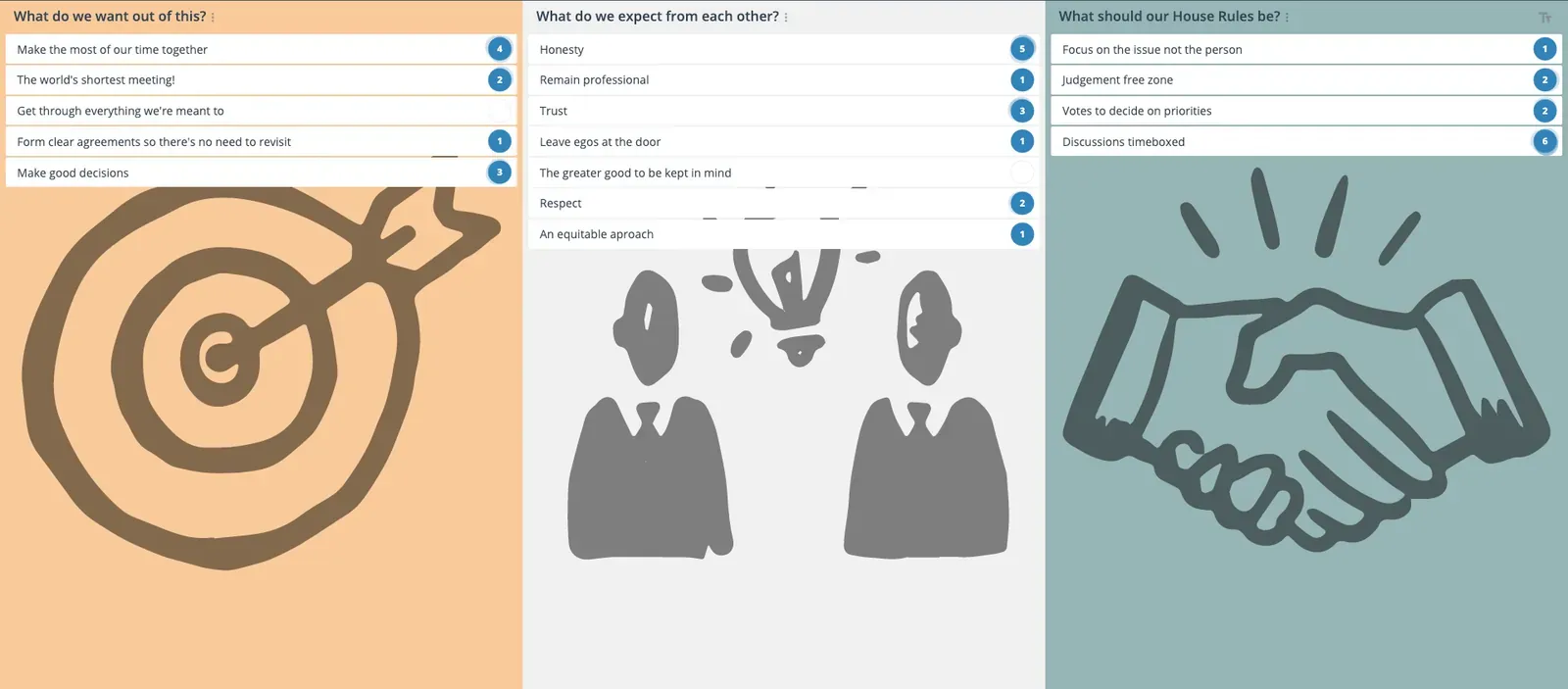
What is the House Rules icebreaker?
The House Rules icebreaker is a group activity that translates each participant’s expectations into a set of rules the group agrees to follow. The rules apply specifically to that group in order for them to engage with the task at hand.
Each set of rules will differ from group to group. This is because they will reflect the expectations and preferences of the ‘House’, that is, the individuals that contributed to them.
The House Rules icebreaker doesn’t require participants to share personal details. Instead, it uses the commonality of group membership to springboard into discussion. This makes it an ideal icebreaker for more formal environments, or for groups that are wary of more creative warm-ups.
Why do a House Rules icebreaker?
The House Rules icebreaker offers two valuable outcomes from one simple activity. As well as the benefits of an icebreaker, this exercise creates a set of guidelines for the group to follow throughout the session that will follow.
The rules make clear what is expected of each participant as well as what they can expect of others. The collaborative process used to shape the rules means participants have a sense of ownership of the guidelines they are following. This increases the likelihood of the rules being followed.
Such rules are a useful reference point for a facilitator. As well as gaining insight into how the group wishes to work, the rules give the facilitator permission to politely enforce them. For example, if the rules include timeboxing conversations, the facilitator may bring discussions to a close once the time limit is reached. Such an action isn’t a reflection of a topic or an individual; it’s just a result of the agreed rules, and it’s therefore unlikely to cause offense.
House Rules icebreaker template
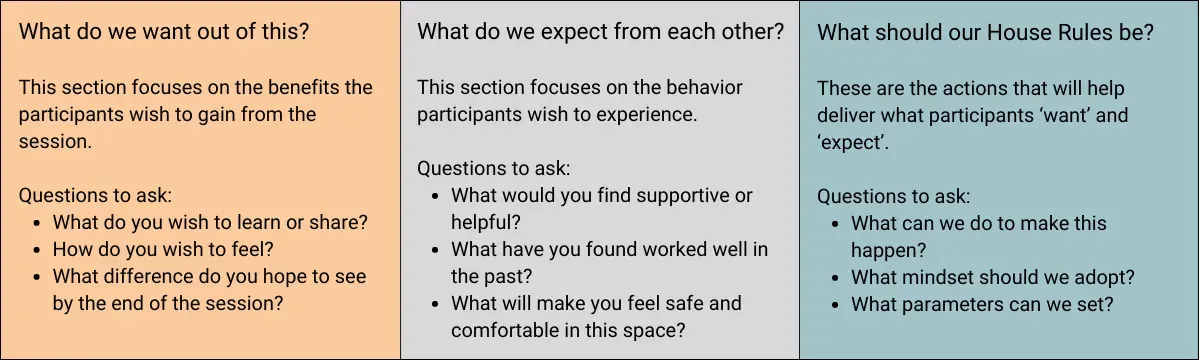
Photo Wall icebreaker
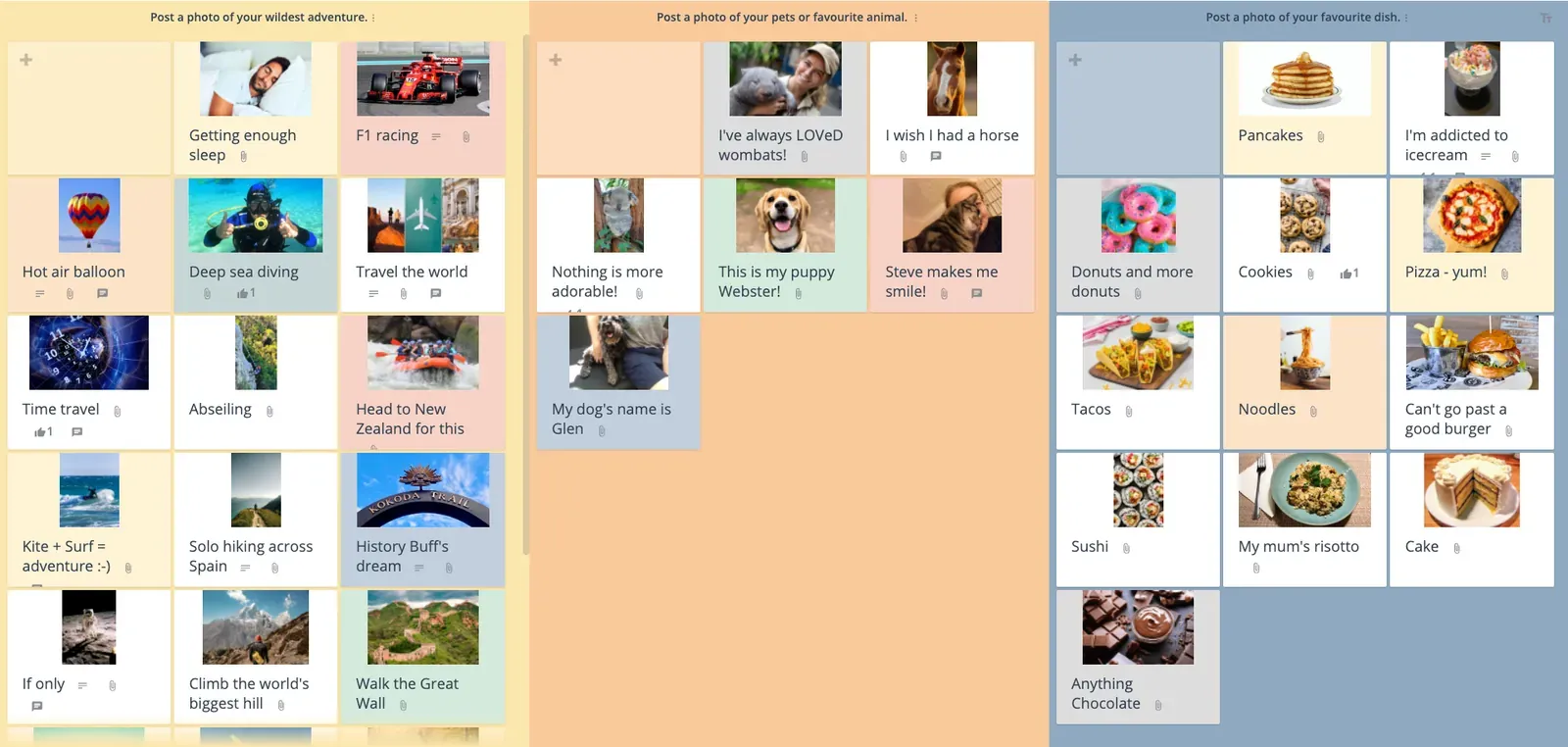
What is the Photo Wall icebreaker?
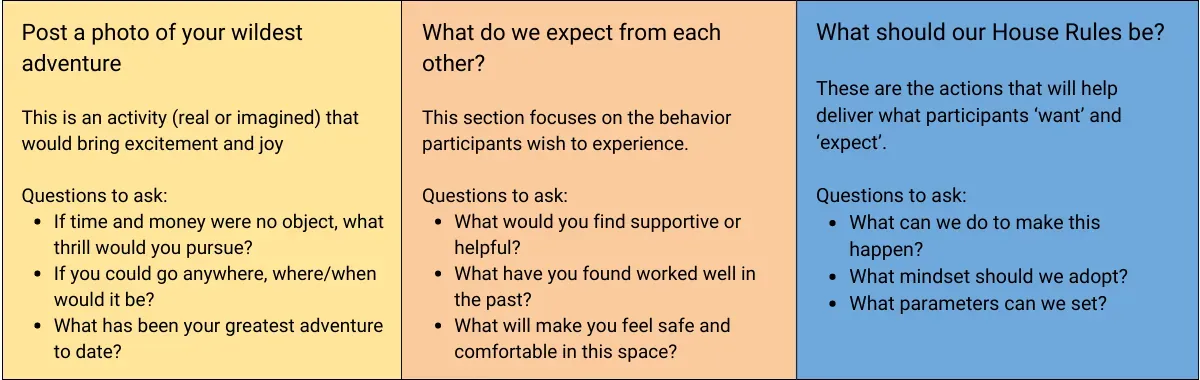
The Photo Wall icebreaker is a group activity that has participants build a simple collage that is used as a common talking point for the group. Every member of the group is invited to share a friendly fact about themselves by way of a photograph they are happy to share. The result is an inviting and colorful poster everyone in the group can explore.
The Photo Wall offers a facilitator a great deal of flexibility. It can include a single or multiple sections depending on the size of the group. Of course, the prompts themselves can be altered to reflect the interests of the group, and the activity at hand.
Why do a Photo Wall icebreaker?
People are more likely to be engaged by a photo than words on a page. They naturally spark curiosity, which is the perfect mindset for a collaborative session. Participants can use their own photos or any photo they can find on the internet. This means they can determine how much of themselves they share. This is great news for a facilitator looking to support a sense of safety in the shared space. The use of photos comes with an added bonus. People don’t need to worry about bad writing or spelling mistakes.
Another great thing about the Photo Wall icebreaker is its broad application. The customization of the prompts means an almost limitless variety can be created ranging from the topical to the timeless. They can also be used by groups of any size.
Photo Wall icebreaker template
Two Truths and One Lie icebreaker
What is the Two Truths and One Lie icebreaker?
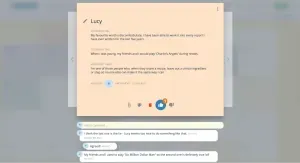
The Two Truths and One Lie icebreaker is based on an old-fashioned parlor game. People share two facts about themselves (truths) and one thing that’s completely made up (lie). Once everyone has added their input to the template, group members are invited to guess which statement is a lie.
Two Truths and One Lie allows participants to share to a level they feel comfortable. It also gives them a chance to draw upon their creative side.
As well as giving participants a chance to get to know each other, the Two Truths and One Lie icebreaker helps a facilitator get to know the personality types that make up the group. More outgoing personalities are likely to offer their opinions on what is true and what is a lie, while quieter participants will need to be invited to do so. The more creative personalities may offer quite unusual ‘facts’ while more conservative participants will offer simpler input.
How to run a Two Truths and One Lie icebreaker?
First, ask everyone who is present to add their names to the board.
Then each person clicks on their name in GroupMap and enters three statements. One of them being a lie.
Then the facilitator can lead everyone through one person’s name at a time and have people comment as to which one they think is a lie and why.
When time is up, the person then reveals to everyone which one the lie was.
Where in the World icebreaker
What is the Where in the World icebreaker?
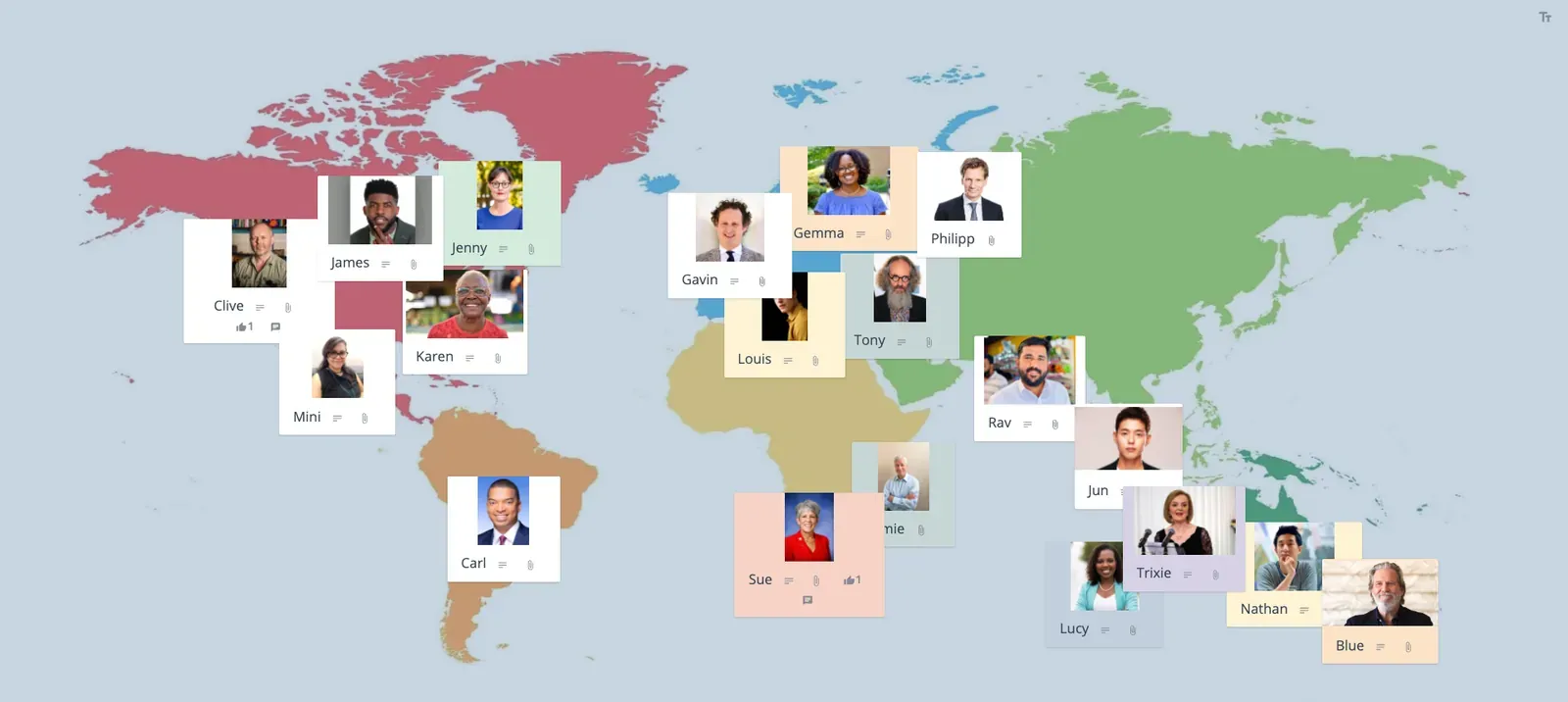
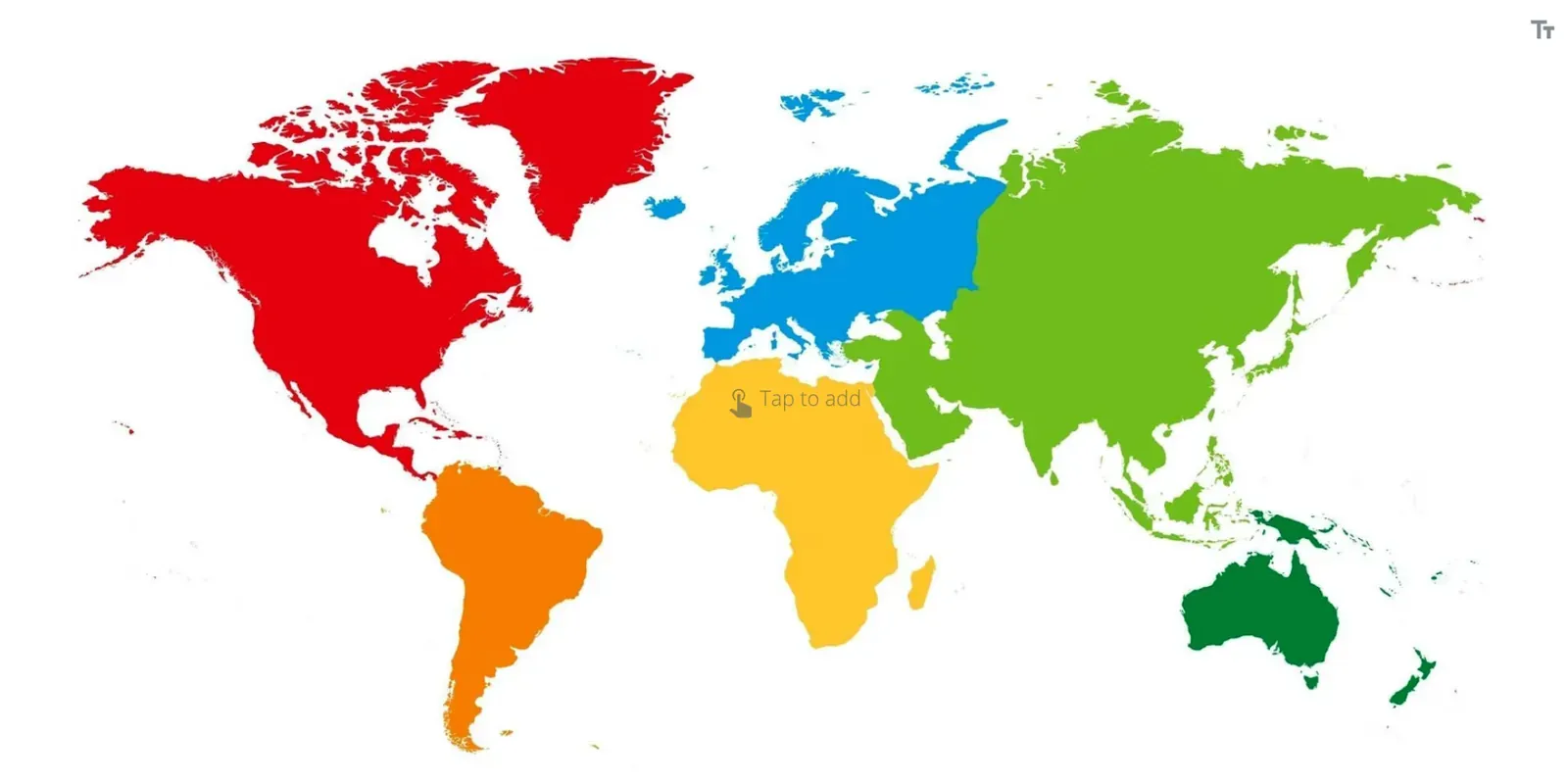
The Where in the World icebreaker is a group activity where participants align themselves to a location. For remote groups, that location can be the country from which they are working. For co-located groups, that location can be the place they were born. For existing groups, that location can be the country they hope to visit one day.
Each group member is invited to place a photo of themselves at the location of their choosing. If time permits, other details can be added and worked into the introduction.
Why do a Where in the World icebreaker?
The Where in the World icebreaker is highly inclusive, after all we all exist somewhere in the world. It is a great way of starting to celebrate diversity and explore what people have in common.
For remote groups, the Where in the World icebreaker can help humanize the virtual collaborative space. This is important as it tends to encourage greater empathy amongst group members.
Where in the World icebreaker template
Who should use an icebreaker?
Anyone who wishes to get more out of their collaborative, meeting, workshop or lesson. This could be because there is a new group of people, or there is a new person to the team. It can also be used to encourage at least everyone saying something at a meeting and to help overcome any initial fears.
Icebreakers are a proven way of supporting engagement and focus. As such they should be used by:
- Facilitators
- Trainers
- Teachers
- Coaches
- Workshop practitioners
In short, anyone overseeing group interaction who is looking to support that group’s effectiveness would benefit from their use.
How to run an icebreaker
An icebreaker helps to set the scene for the session that follows, so it’s important for a facilitator to begin as they wish to go on.
When it comes to online sessions, there are a variety of tools to help. Screen sharing software, video conferencing and online collaboration tools such as GroupMap allow facilitators to deliver inclusive icebreakers.
GroupMap’s icebreaker templates are deliberately simple in design. This is because most of the time spent during the icebreaker should be spent talking and getting to know each other. Unlike a simple poll, where people get lost in a stack of numbers, these icebreaker questions are non-threatening and let each person share freely without fear. There are no wrong answers.
An online icebreaker also doubles as a dry run of the tool itself: by the time the warm-up ends, everyone has joined, added a card and seen their contribution appear, so the first working session does not stall on someone who cannot get in.
Related templates
- Icebreakers for large groups: what changes once the room is too big to go around, and five activities that scale.
- Mood Wall: a one-glance read on the state of the room before you start.
- The ESVP: find out who arrived as an explorer, shopper, vacationer or prisoner.
- Meeting agenda template: plan the session the warm-up is opening.
- Lean Coffee: let the group set the agenda it actually wants to discuss.
References
- Icebreakers Are Terrible. They Also, Unfortunately, Work Really Well.
- The Effect of an Icebreaker on Collaborative Performance Across a Video Link.
- What makes the best icebreakers for teams?
- Icebreaker questions & games
Save effort, time and money with GroupMap
GroupMap offers more than just an online digital whiteboard. Its innovative platform is designed to enhance the quality of your team’s decisions. With features that prevent bias and keep facilitation simple, GroupMap makes sure no single voice dominates and keeps conversations productive and inclusive. Its intuitive interface is easy for anyone to use, and its scalable design supports small teams and large groups whether they are face to face or around the globe. Customizable templates and workflows keep discussions focused on objectives, helping you drive actionable outcomes each and every time.
Frequently asked questions
What is an icebreaker?
What makes a good icebreaker?
What are some good team icebreakers?
Do icebreakers work for remote teams?
Who should use icebreakers?
How do you choose the right icebreaker?
How long should an icebreaker take?
What icebreakers work for a large group?
What should you do if nobody responds to an icebreaker?
How to run it in GroupMap

Brainstorm
Add input to the template.

Discuss
Explain the input and why it was included.
Ready to get everyone on the same page?
Start a free GroupMap and turn your next discussion into clear, shared decisions.